What Causes Aphantasia: Science, Genetics, and Brain Connectivity Explained
Have you ever closed your eyes and tried to picture a sunset, only to see a blank screen? If "visualizing" feels like a metaphor you don't understand, you are likely experiencing aphantasia. This inability to create voluntary mental images can feel confusing, leaving many to wonder: Was I born this way, or did something happen to me?
This guide explores exactly what causes aphantasia, breaking down the science of brain connectivity, the role of genetics, and rare cases of acquired aphantasia. Whether you are seeking answers for yourself or considering taking an online aphantasia test to confirm your traits, understanding the cause is the first step toward self-acceptance.
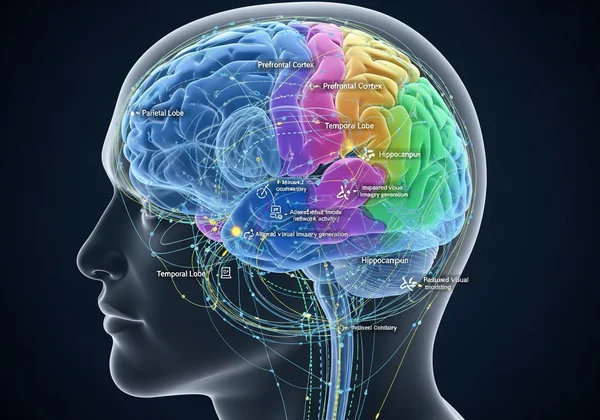
Congenital Aphantasia: Born Without Mental Imagery
For the vast majority of people, what causes aphantasia is simply their biology. This is known as congenital aphantasia, meaning you have had it since birth. It isn't a condition you "caught" or a skill you forgot; it is a lifelong trait, much like being left-handed or having a specific eye color.
Most people with congenital aphantasia assume everyone else is speaking metaphorically when they say "picture this." It often takes years—sometimes decades—to realize that other people can actually see images in their minds.
Is Aphantasia Hereditary? The Family Link
If you have aphantasia, there is a good chance you are not the only one in your family tree. Research strongly suggests that aphantasia is hereditary. Studies indicate that people with aphantasia are significantly more likely to have a first-degree relative—like a parent or sibling—who also lacks a mind's eye.
While scientists haven't pinpointed a single "aphantasia gene," the pattern of inheritance points to a complex genetic component. It’s worth asking your family members about their own visualization abilities. You might be surprised to find that your "blind mind's eye" is a shared family trait.
Developmental Traits: Why It’s Not a "Defect"
A common fear is that congenital aphantasia is a developmental disorder or a learning disability. This is a misconception. Aphantasia does not affect your intelligence (IQ), your ability to learn, or your creative potential.
Many successful artists, scientists, and writers have aphantasia. Instead of relying on visual memory, their brains often develop robust verbal, logical, or spatial reasoning strategies. Think of it not as a missing piece, but as a different operating system. Your brain processes information perfectly well; it just uses a different pathway to get there.
The Neuroscience: What Happens in the Brain?
To understand what causes aphantasia, we have to look inside the brain. Visualization isn't magic; it is a complex network of signals. For most people, when they think of an apple, their frontal lobe (the decision-making center) sends a command to the visual cortex (the part that sees).
In aphantasia, this specific network behaves differently.
The Disconnection Theory: Frontal Lobe vs. Visual Cortex
Current neurological theories suggest that aphantasia is caused by a "dampened" connection between these two key brain regions.
Here is a simple way to visualize the science:
- The Request: Your frontal cortex decides to "see" an apple.
- The Signal: It sends a message backward to the visual cortex.
- The Result: In a typical brain, the visual cortex activates, creating a mental image. In an aphantasic brain, the signal is too weak to trigger that visual re-creation.
The visual cortex itself works fine—you can see with your eyes perfectly well. The issue lies in the voluntary retrieval of images from memory.
Visualizing the Gap
Imagine a computer that is not connected to a monitor. The computer (your frontal lobe) is running the program perfectly. It knows what the image should be. However, the cable connecting it to the screen (the visual cortex) is unplugged or faulty.
The data is there—you know what an apple is, you know it's round and red—but the screen remains black. This "disconnection" is the leading scientific explanation for what causes aphantasia in the brain.
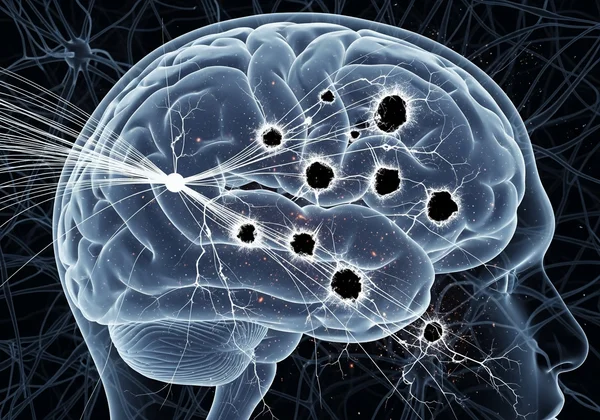
Acquired Aphantasia: Can Trauma or Injury Cause It?
While rare, it is possible to lose the ability to visualize. This is known as acquired aphantasia. Unlike congenital cases, people with this form remember what it was like to visualize and often find the loss distressing.
If you previously had a vivid imagination and suddenly lost it, the cause is likely external rather than genetic.
Psychological Factors: Can Stress Block the Mind's Eye?
Can emotional trauma cause aphantasia? The answer is yes, in some cases. Severe psychological stress, anxiety, or depression can trigger a "shut down" of mental imagery. This is often viewed as a protective mechanism. If visualizing memories is painful (as with PTSD), the brain may suppress its ability to create images to protect you from reliving trauma.
This type of aphantasia is sometimes psychogenic, meaning it originates from psychological processes. In these instances, visualization might return as the underlying trauma is processed, though this varies from person to person.
Physical Causes: Stroke, Surgery, and Injuries
Physical damage to the brain can also disrupt the delicate network required for visualization.
- Head Injuries: Concussions or traumatic brain injuries can impact the brain's wiring.
- Stroke: If a stroke affects the posterior cerebral artery or the visual cortex directly, visualization can be lost.
- Surgery: Rarely, brain surgery can inadvertently affect these pathways.
If you have experienced a sudden loss of visualization following a medical event, it is important to discuss this symptom with a neurologist, as it provides clues about the specific areas of the brain that were affected.
Neurodiversity Connections: ADHD, Autism, and the Mind
When exploring what causes aphantasia, many people find themselves crossing paths with other forms of neurodiversity. There is a notable overlap between aphantasia and conditions like Autism Spectrum Disorder (ASD) and ADHD.
The Overlap Between Aphantasia and Autism
Some studies suggest a higher prevalence of aphantasia among autistic individuals. Both conditions involve differences in sensory processing. While autism affects how you process external sensory input, aphantasia affects how you process internal sensory simulation.
If you are on the autism spectrum, you might find that your thinking style is highly systematic or logic-based, which aligns with the non-visual nature of aphantasia. However, one does not cause the other; they are simply distinct traits that often co-occur.
ADHD and the Non-Visual Mind
Is there a link between aphantasia and ADHD? Many people with ADHD report having either extremely vivid imagery (hyperphantasia) or none at all.
For those with ADHD and aphantasia, memory retrieval can be tricky. Since you cannot "replay" a visual memory of where you left your keys, you rely entirely on semantic memory (knowing facts) or muscle memory. Understanding this connection can help you build better organizational strategies that don't rely on a "mind's eye" you don't have.
A Quick Checklist: Signs Your "Causes" Are Biological
Before you jump to conclusions, it helps to verify if what you are experiencing is truly aphantasia. Sometimes, we misinterpret our own internal experiences.
Use this quick checklist to see if your experience aligns with the biological traits of aphantasia:
- The "Apple Test": Close your eyes and imagine a red apple. Do you see color and shape, or do you only "know" it is an apple? (Seeing nothing = Aphantasia).
- Visual Memory: Can you picture the face of a loved one, or do you just remember facts about their appearance (e.g., "she has blue eyes")?
- Involuntary Imagery: Do you dream visually? Many people with aphantasia can see images in dreams. This confirms your visual cortex works; the issue is only with voluntary control while awake.
- Sound and Touch: Can you imagine a song playing or the feeling of sand? Some aphantasics lack all senses in their mind (total aphantasia), while others only lack visuals.
If you answered "no" to seeing the apple or faces but "yes" to visual dreams, your profile strongly fits the neurological model of congenital aphantasia.
Measuring the Spectrum: How to Explore Your Mind’s Eye
Understanding what causes aphantasia—whether it is your genetics or brain wiring—is a huge relief. It validates that you aren't "doing it wrong"; you are just built differently.
The next logical step isn't a medical diagnosis (since this isn't a disease), but rather self-discovery. Visualization isn't black and white; it's a spectrum. Some people see nothing, while others see faint, ghostly outlines. Knowing exactly where you fall on this spectrum can help you understand your learning style and cognitive strengths.
Understanding the VVIQ Scale
The gold standard for measuring this trait is the Vividness of Visual Imagery Questionnaire (VVIQ). It is the same tool used by researchers in the studies mentioned above to identify aphantasia.
The VVIQ asks you to visualize specific scenarios (like a sunrise or a shop front) and rate the clarity of the image. It turns a vague feeling into a concrete score.
Self-Discovery, Not Diagnosis
We provide a specialized tool to help you navigate this. It is designed to be educational and reflective.
If you are curious about your own visualization ability, consider taking our VVIQ Aphantasia Test. It is free, takes only a few minutes, and provides immediate insight into your cognitive profile.
Taking this step can move you from asking "Why am I like this?" to understanding "How can I use this to my advantage?"
A Different Way of Thinking
Whether your aphantasia is caused by genetics, brain connectivity, or life experiences, it is a fundamental part of who you are. It is not a barrier to success or creativity; it is simply a different way of thinking.
By understanding the causes, you free yourself from the pressure to "try harder" to visualize. Instead, you can focus on the unique strengths of your non-visual mind—your logic, your verbal precision, and your ability to engage with the present moment without the distraction of mental images.
For deeper insights into your results, explore our comprehensive aphantasia test guide to learn more about your unique cognitive traits.
Frequently Asked Questions
Why can I dream but not visualize while awake?
This is very common. Dreaming is an involuntary process driven by the brainstem and visual cortex (bottom-up processing). Voluntary visualization requires the frontal lobe to "command" an image (top-down processing). In aphantasia, the voluntary cable is unplugged, but the screen (visual cortex) still works during sleep.
Is aphantasia linked to high IQ?
There is no direct correlation between aphantasia and low or high IQ. People with aphantasia span the entire intelligence spectrum. Some evidence suggests aphantasics may excel in scientific or mathematical fields due to strong logical processing, but this is a trend, not a rule.
Is aphantasia considered a disability?
No, aphantasia is generally considered a neurodivergent trait, not a disability. It does not prevent you from living a full, independent life. However, it can make certain tasks (like describing a suspect to a sketch artist or rotating 3D objects mentally) more challenging.
Can you cure congenital aphantasia?
Currently, there is no known "cure" for congenital aphantasia, and most experts argue it doesn't need curing. Some people experiment with "Image Streaming" exercises to improve visualization, but results are mixed. Acceptance and adaptation are usually more effective than trying to force the brain to change its wiring.
Can anxiety or depression cause aphantasia?
Yes, in the context of "psychogenic aphantasia." Severe anxiety or depression can dampen mental imagery as a coping mechanism. If you suspect your aphantasia is linked to mental health struggles, speaking with a therapist is a recommended step to address the underlying cause.