Visualizing Apple: What the Apple Test Says About Your Mind's Eye
Visualizing apple is one of the simplest ways people compare inner experience: close your eyes, picture an apple, and notice what actually shows up. Some people see a bright red fruit with shine, shadow, stem, and texture. Others get a faint outline, a concept, a word, or nothing visual at all. None of those responses automatically makes your imagination better or worse. They may simply point to where your mind sits on the visual imagery spectrum. If the exercise leaves you curious, an educational mind's eye self-reflection tool can help you explore the same question in a more structured way.
What Does Visualizing an Apple Mean?
The apple exercise asks you to observe voluntary visual imagery. That means the image, if there is one, is created intentionally in the mind rather than seen with the eyes. You might imagine the apple on a table, floating in darkness, or sitting in your hand. You might know it is red without seeing red. You might sense its roundness spatially but not visually. You might picture it briefly, then lose it.
That variety is exactly why the apple test became popular online. It gives people a concrete object to compare, yet it reveals how slippery words like "see," "picture," and "visualize" can be. For one person, "I can see it" means a nearly photographic inner image. For another, it means knowing the facts about an apple well enough to describe or draw one. Both people may be using honest language, but describing different inner events.
The key is not whether your answer fits a meme perfectly. The useful question is: when you try to visualize, how much visual detail arrives, how stable is it, and does it feel like an image or more like knowledge?
The Apple Visualization Scale, From Vivid to Blank
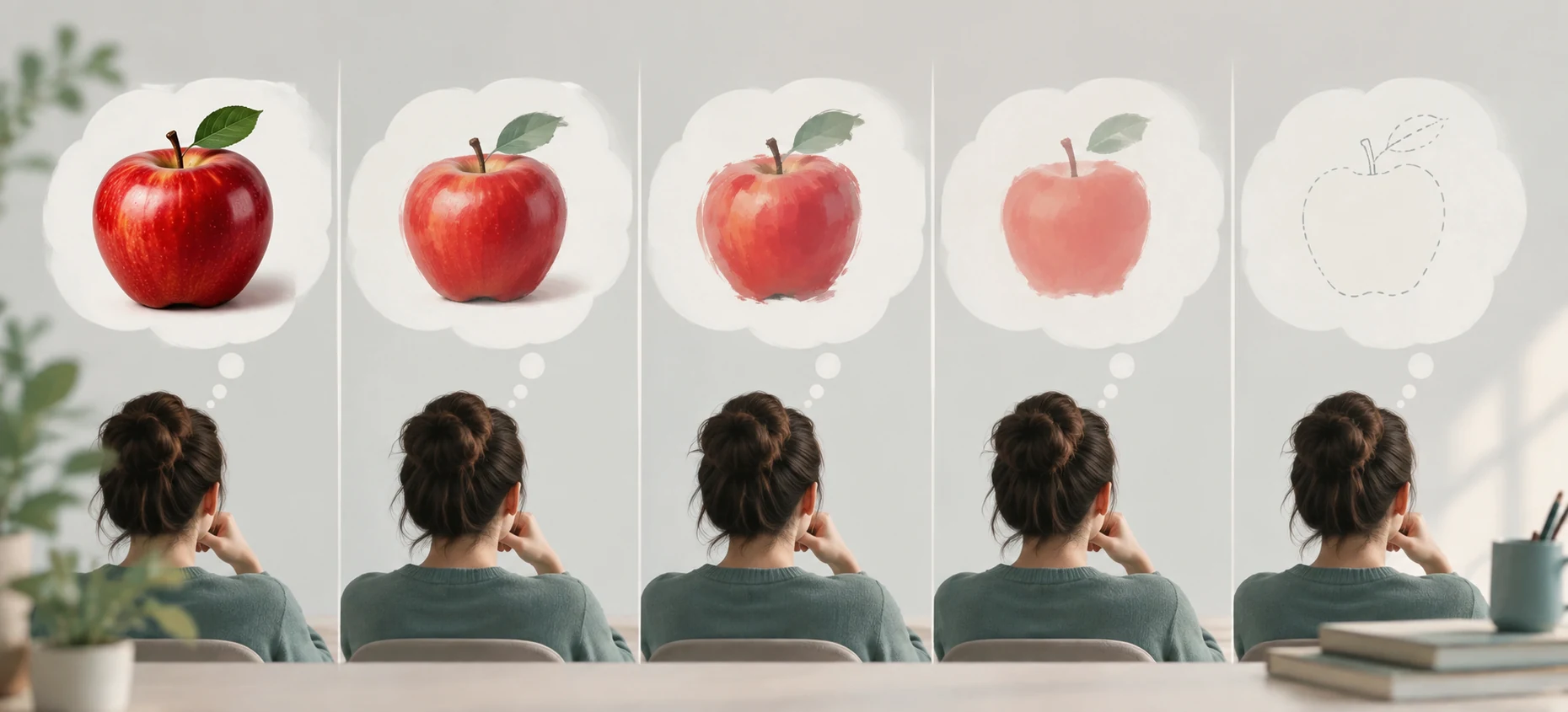
A practical apple visualization scale usually runs from vivid imagery to no voluntary image. The exact numbers change across diagrams, so it is better to treat the scale as a guide rather than a scorecard.
At the vivid end, the apple may appear clear, colorful, and stable. You may notice highlights on the skin, a brown stem, a shadow under the fruit, or small color variations. Some people can rotate the apple in the mind and inspect it from different angles. That does not necessarily mean they have unusual intelligence or artistic talent; it means the visual component of their imagination is strong.
In the middle, the apple may be present but incomplete. You may get a rough shape, a red-ish patch, a short flash, or an image that fades when you pay attention to it. Many people live in this middle zone and only realize it when comparing notes with someone at either extreme.
At the low-imagery end, the apple may not appear visually. You may still know exactly what an apple is. You may list its features, remember eating one, plan how to draw one, or understand its position in space. The difference is that the experience does not feel like seeing an inner picture. This low or absent voluntary imagery is often what people are exploring when they search for an aphantasia apple test.
How to Try the Apple Test Without Overreading It
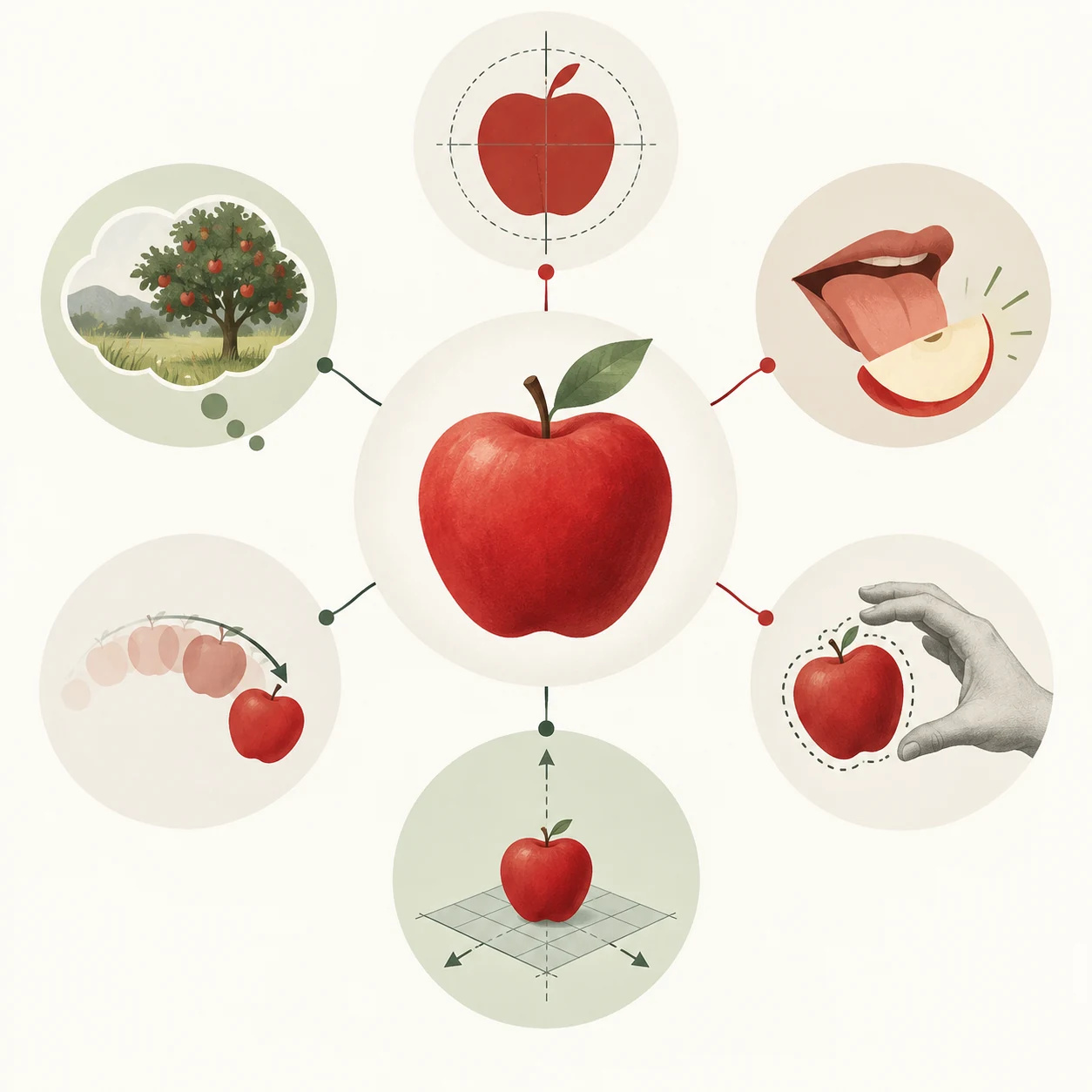
To try the exercise, choose a quiet moment and imagine a familiar apple for about 20 to 30 seconds. You do not need to force anything dramatic. Notice color, outline, depth, texture, movement, and stability.
Then ask yourself a few grounded questions:
- Did I experience a visual image, or did I mainly think about the idea of an apple?
- Was the image clear, dim, fleeting, or absent?
- Could I change the apple's color, size, or angle?
- Did closing my eyes help, make no difference, or make the task stranger?
- Could I describe the apple even if I did not see it?
This reflection is more useful than chasing the perfect number. A single apple exercise can be influenced by fatigue, stress, interpretation, expectation, and the object you choose. A more complete visual imagery self-check asks across multiple scenes because one prompt rarely captures the whole mind's eye.

Visualizing Apple and Aphantasia
Aphantasia is commonly described as the inability or strong difficulty of voluntarily forming visual mental images. If you cannot picture an apple, the experience may feel surprisingly ordinary to you, especially if you have always thought this way. Many people only notice the difference when they learn that others are not speaking metaphorically when they describe pictures in the mind.
Still, one apple prompt is not enough to define your whole cognitive style. Some people have no voluntary apple image but still dream visually. Some get involuntary flashes but cannot summon images on command. Some have weak object imagery but strong spatial thinking. Some can imagine sounds, movement, words, emotions, or concepts more easily than pictures.
It is also important to separate visual imagery from imagination itself. If you do not see an apple in your mind, you can still imagine a story, solve a problem, design a system, remember facts, enjoy fiction, and make art. Visual imagery is one route into imagination, not the whole landscape.
Does the Spinning Apple Say Anything About IQ?
Searches around "spinning apple IQ" usually come from a tempting idea: if you can rotate an apple in your head, maybe that proves something about intelligence. The safer answer is no. Mental rotation can be part of spatial thinking, and spatial reasoning can matter for some tasks, but an apple spinning exercise is not an IQ measure.
People with low visual imagery may still reason spatially, work with maps, understand geometry, build technical systems, or solve complex problems by using conceptual, verbal, kinesthetic, or rule-based strategies. People with vivid imagery may find some visual tasks easier, but they may also differ widely in attention, memory, anxiety, creativity, and education.
So if you can spin the apple, treat it as one interesting data point about imagery and mental manipulation. If you cannot, avoid turning that into a global judgment about intelligence. Aphantasia and vivid imagery are better understood as cognitive differences than as a simple ladder from worse to better.
Why the Apple Test Feels So Surprising
The apple test is memorable because it exposes a hidden assumption. We use shared words for private experiences. "Picture an apple" sounds simple, but no one can directly inspect another person's mind's eye. That makes the conversation both fascinating and easy to misunderstand.
For vivid visualizers, the surprise may be that some people are not withholding effort; the picture simply does not appear. For non-visual thinkers, the surprise may be that other people can summon color, shape, and texture intentionally. Both discoveries can feel disorienting at first.
A good response is curiosity. Instead of asking whether one style is normal enough, ask what each style makes easier, harder, or simply different. You might notice that you remember stories by plot rather than image, navigate by routes rather than landmarks, plan designs through words and constraints, or feel emotions without visual scenes attached. Those observations are often more helpful than a single label.
A Gentle Way to Interpret Your Apple Experience
If visualizing apple gave you a strong image, you may have relatively vivid visual imagery for simple objects. Notice whether that vividness carries over to faces, places, memories, future scenes, and reading. Imagery can vary by category.
If you got a faint or unstable apple, you may sit somewhere in the broad middle of the imagery spectrum. That middle is common and often overlooked because online diagrams tend to dramatize the extremes.
If you got no image, your experience may overlap with aphantasia, especially if the same thing happens across many voluntary visualization prompts. That does not make your mind empty. It may mean your imagination leans more on concepts, language, spatial structure, emotion, logic, or other senses.
For a calmer next step, compare the apple exercise with a structured aphantasia self-exploration test that treats results as insight rather than a clinical conclusion. Bring any serious memory, neurological, or mental health concerns to a qualified professional, especially if your imagery changed suddenly or follows an injury, illness, or major life event.
FAQ
How do you visualize an apple?
Choose a familiar apple and try to bring it to mind intentionally. Notice whether you see color, shape, shine, stem, shadow, or texture. Then notice whether the image is stable or fleeting. If no picture appears, check whether you still know facts about the apple conceptually.
What does it mean if I cannot picture an apple?
It may mean you have low or absent voluntary visual imagery, especially if the same thing happens with many other objects and scenes. It does not mean you lack imagination, memory, intelligence, or creativity. The apple exercise is a reflection prompt, not a standalone clinical assessment.
Is the apple visualization scale the same as an aphantasia test?
No. The apple visualization scale is a quick comparison tool. A broader imagery questionnaire asks about multiple scenes and degrees of vividness, which gives a more balanced picture of your visual imagery style.
Does aphantasia mean high IQ?
No single apple or aphantasia exercise can tell you your IQ. Research and lived experience suggest people across the imagery spectrum can be highly capable, but imagery vividness should not be treated as an intelligence score.
Is having aphantasia rare?
Aphantasia appears to be uncommon, but estimates vary depending on how researchers define and measure it. It is better to think of it as one end of a wider visual imagery spectrum rather than as a simple yes-or-no category.
Can you have aphantasia and still dream in pictures?
Yes, some people report little or no voluntary visual imagery while still having visual dreams or occasional involuntary flashes. Voluntary imagination, dreaming, memory, and perception are related but not identical experiences.
What famous people have aphantasia?
Public discussions often mention successful artists, technologists, writers, and scientists who report aphantasia or very low visual imagery. The practical takeaway is not to compare yourself to a celebrity, but to remember that image-free thinking can coexist with creative and technical achievement.