Is Aphantasia Real? What Science Says About the Mind's Eye
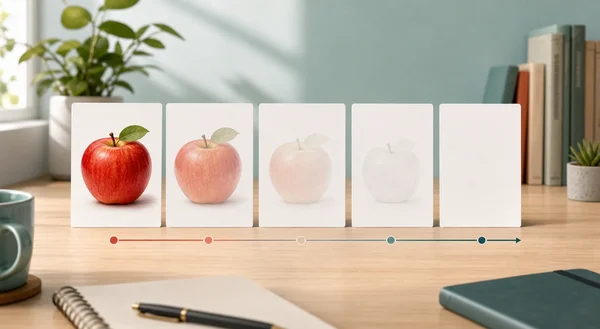
Yes, aphantasia is real, but it is also easy to misunderstand. It does not mean a person has no imagination, no memory, or no creativity. It means voluntary visual imagery is absent or very weak: when someone tries to picture an apple, a familiar face, or a beach, no clear mental picture appears. If you are trying to compare your own experience with other people's descriptions, a gentle mind's eye self-check can give you language for reflection without turning the result into a medical conclusion.
The tricky part is that mental imagery is private. No one can open another person's head and inspect the picture. So the best answer is balanced: aphantasia is scientifically studied and supported by multiple kinds of evidence, while individual self-assessment still needs humility.
What "Real" Means for Aphantasia
In everyday language, "real" can mean "visible from the outside." Aphantasia is not visible in that simple way. It is an inner experience, like the vividness of a dream, the tone of an inner voice, or the emotional texture of a memory. People can describe it, compare it, and study it, but it is not a bruise or a broken bone.
In cognitive science, "real" means something more useful: a pattern is consistent enough to define, measure, and connect with observable differences. Aphantasia fits that standard. Researchers have studied people who report little or no voluntary visual imagery, often using tools such as the Vividness of Visual Imagery Questionnaire, or VVIQ. Other studies compare memory, drawing, physiology, and brain-related measures across people with different imagery vividness.
That does not make every online claim perfect. It means the basic phenomenon is not just an internet myth. Human minds vary, and visual imagery appears to sit on a spectrum from no image, to vague or dim imagery, to extremely vivid imagery.
Why People Doubt It
Skepticism is understandable because the word "see" is messy. When one person says, "I can see it in my mind," they may mean a vivid inner picture. Another person may mean a factual sense of knowing. A third person may expect a literal image behind closed eyelids and think they are failing because the experience is not like ordinary vision.
This is why online discussions about "is aphantasia real reddit" can become confusing. People are comparing private experiences with language that was never designed for precision. Some people with typical imagery do not see a bright movie screen. Some people with aphantasia still have spatial knowledge, emotional memory, dreams, or sudden image-like flashes. Others use words, facts, body sensations, or abstract structure instead of pictures.
The question is not whether everyone who wonders about aphantasia has the same experience. They do not. The better question is whether some people reliably report little or no voluntary visual imagery, and whether that difference lines up with research findings. The answer is yes.
How Scientists Study Aphantasia
The most common starting point is a structured self-report measure. The VVIQ asks people to imagine familiar scenes and rate how vivid the mental image is. The classic format uses 16 items, and each item asks about a specific visual detail. Scores help place someone along the visual imagery spectrum rather than reducing the mind to a single yes-or-no label.
Self-report alone has limits, so researchers also look for patterns that go beyond "I say I cannot see it." For example, drawing-from-memory studies suggest that people with aphantasia may recall fewer visual object details while still preserving spatial layout better than expected. Other work has explored differences in autobiographical memory, face recognition, dreams, visual working memory, and physiological responses to imagined scenes.
None of this means an online quiz can prove everything about your mind. It does mean a VVIQ-style imagery questionnaire is a reasonable educational starting point when used as reflection, not as a formal clinical label. The strongest approach is to combine your scores with careful examples from daily life: faces, memories, reading, navigation, creativity, and dreams.

Is Aphantasia Rare, Genetic, or a Disability?
Aphantasia appears to be uncommon, but estimates vary because researchers draw the line in different places. Some studies focus on people with no voluntary visual imagery at all. Others include people whose imagery is only vague or dim. A cautious public-facing estimate is that a small minority of people experience aphantasia or very low imagery, often discussed in the range of roughly one to a few percent.
Is aphantasia genetic? There is evidence that it can run in families more often than chance would predict, especially for lifelong aphantasia. That does not mean a single known gene explains it, and it does not mean every family member will share the same imagery style. The current picture is more like a heritable tendency that still needs more research.
Is aphantasia a disability? For many people, no. Lifelong aphantasia is often described as a cognitive difference rather than a disorder. People with aphantasia can be artists, engineers, writers, teachers, designers, parents, athletes, and problem-solvers. Some people do find it affects autobiographical memory, visualization-heavy study advice, face imagery, or emotional connection to past events. The impact depends on the person, the context, and the strategies they have built.
One boundary matters: if someone suddenly loses imagery after previously having vivid mental pictures, especially alongside other cognitive or neurological changes, that is different from lifelong aphantasia. Sudden change is a good reason to speak with a qualified health professional.
What Aphantasia Can Feel Like in Daily Life
What is aphantasia like? A common description is "I know, but I do not see." You may know your friend's face, recognize them instantly, and remember facts about their appearance, yet be unable to summon a visual image of that face. You may know the layout of your childhood home without mentally walking through a detailed movie of it. You may enjoy fiction through plot, language, emotion, and ideas rather than visual scenes.
People often discover aphantasia when a familiar phrase suddenly stops sounding metaphorical. "Picture a beach" may be literal for some people. "Counting sheep" may involve actual sheep-like imagery. "Replay the moment" may feel like a visual scene for one person and a factual timeline for another.
A quick reflection checklist can help:
- When you try to imagine a familiar face, do you see details or mostly know facts?
- Are memories visual, verbal, emotional, spatial, or mainly conceptual?
- Do you dream visually, even if waking imagery is absent?
- Do you plan by pictures, lists, maps, sensations, words, or rules?
- Do visualization exercises feel natural, vague, frustrating, or simply empty?
There is no prize for forcing your answer into someone else's language. The useful goal is accuracy about your own experience.
What Aphantasia Is Not
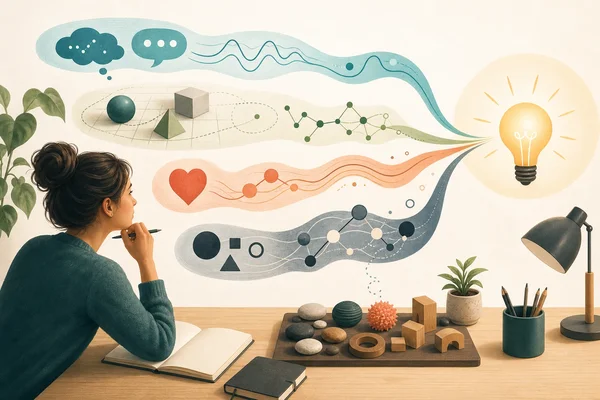
Aphantasia is not the same as lacking imagination. Imagination can be visual, but it can also be conceptual, verbal, emotional, musical, spatial, logical, or sensory in non-visual ways. A person can invent a story, solve a design problem, remember a route, or understand a metaphor without seeing mental pictures.
It is also not automatically bad. Some people feel grief when they realize others can visualize loved ones or memories more vividly. Others feel relief because a lifelong difference finally has a name. Many feel both at different times. That mixed reaction is normal.
Is aphantasia neurodivergent? Some people use that word because aphantasia reflects a meaningful difference in cognition. Research has also explored links with traits such as autism-like characteristics, memory style, and sensory imagery differences. Still, aphantasia by itself should not be treated as proof of any broader identity or condition. It is best understood as one part of a person's cognitive profile.
A Balanced Way to Answer "Is Aphantasia Real?"
The best short answer is this: aphantasia is a real, researched variation in voluntary visual imagery, but the honest way to understand it is through careful self-reflection, not overconfident labels. If you cannot picture things in your mind, you are not alone, and you are not broken. You may simply think through knowledge, structure, words, spatial relationships, emotion, or other non-visual routes.
For a practical next step, compare your everyday examples with a low-pressure visual imagery check. Treat the result as a starting point for noticing patterns: how you remember, learn, read, plan, create, and explain ideas. That kind of self-knowledge is the real value. It helps you stop asking, "Is my mind wrong?" and start asking, "How does my mind actually work?"
FAQ
Is aphantasia scientifically proven?
Aphantasia is scientifically studied and supported by converging evidence from questionnaires, behavioral tasks, and research on imagery vividness. Because inner imagery is subjective, science cannot inspect a private picture directly. Instead, it looks for consistent reports and measurable patterns.
Is aphantasia linked to high IQ?
There is no good reason to treat aphantasia as a sign of high or low IQ. People with aphantasia can be strong in many areas, including abstract reasoning, language, systems thinking, art, or practical problem-solving. Intelligence is much broader than visual imagery.
Do you actually see things in aphantasia?
In typical lifelong aphantasia, people usually do not voluntarily see mental pictures when they try to visualize. Some may still have dreams, involuntary flashes, spatial awareness, or a strong sense of knowing what something looks like. That is why "no image" does not mean "no thought."
What are famous people with aphantasia?
Public discussions often mention people such as Ed Catmull and Blake Ross, who have spoken about lacking a typical mind's eye. These examples are useful because they show that creativity and technical achievement do not require vivid mental pictures.
Is aphantasia rare?
Yes, it seems uncommon, though exact estimates depend on the cutoff used. Profound absence of imagery is usually estimated lower than broader low-imagery categories. A cautious takeaway is that aphantasia affects a small but meaningful minority of people.
Is aphantasia genetic?
It may have a familial component. Studies and personal reports suggest lifelong aphantasia can appear among close relatives more often than chance would suggest. Researchers have not reduced it to one simple genetic explanation.
Is aphantasia a disability?
For many people, aphantasia is a cognitive difference rather than a disability. It can create challenges in areas that depend heavily on visual recall or visualization-based advice, but many people adapt through verbal, spatial, factual, or external tools.
Is aphantasia bad?
Not inherently. It can feel unsettling to learn that other people have a kind of mental imagery you do not experience, but aphantasia does not make your mind lesser. It means your imagination may work through different channels.