How Rare Is Aphantasia? What the Numbers Actually Mean
If you have recently learned that other people can actually picture faces, places, or scenes in their mind, one question tends to arrive fast: how rare is aphantasia? The careful answer is that it depends on how strictly researchers define it. Recent VVIQ-based estimates suggest that complete absence of voluntary visual imagery may affect about 1% of people, while a broader low-imagery range may be closer to 4%. In plain language, aphantasia is uncommon, but it is not so rare that you are alone. For many people, exploring visual imagery self-reflection is less about labeling a problem and more about finding clearer words for a familiar inner experience.

The Short Answer: Aphantasia Is Uncommon, Not Extraordinary
The most useful short answer is this: aphantasia appears to be rare compared with typical visual imagery, but common enough that many people will know someone who experiences it.
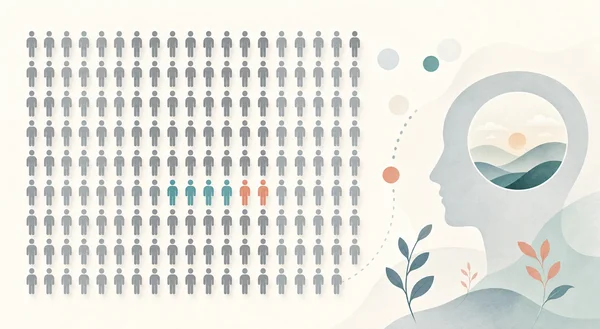
Different sources often give slightly different numbers because they are not always measuring the same thing. A strict definition usually means no voluntary visual image at all. Under that definition, recent large-sample research places aphantasia at roughly 1% of people. A broader definition includes people who can form only vague, dim, or very weak images. Under that wider lens, the estimate moves closer to 4%, or about one in 25 people.
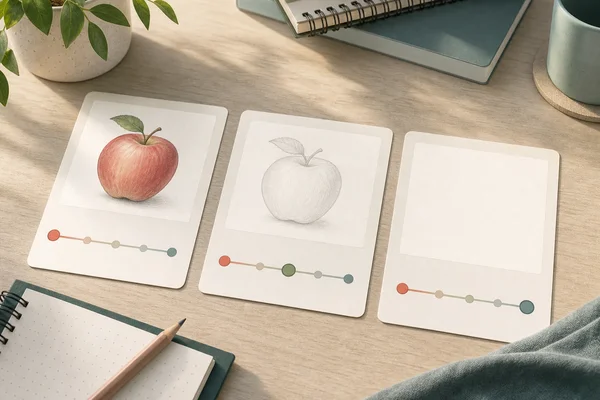
That distinction matters. Someone who sees nothing at all when trying to picture an apple may not have the same experience as someone who sees a faint outline for a second. Both may be near the low end of the imagery vividness spectrum, but researchers may place them in different categories.
So if you see a headline saying aphantasia affects 1% of people, it may be referring to complete absence of imagery. If you see a 3% or 4% estimate, it may be referring to a broader low-imagery group. Neither number is automatically wrong; the difference is usually about definitions.
Why Estimates Range From About 1% to 4%
Research on aphantasia is still young compared with many other areas of psychology and neuroscience. The term became widely used only in the last decade, even though scientists described non-visualizers long before then. Because the field is still settling its definitions, rarity estimates can shift depending on the method.
Complete absence versus very weak imagery
The Vividness of Visual Imagery Questionnaire, often shortened to VVIQ, asks people to rate how vividly they can form mental images. Some studies classify only the lowest possible score as complete aphantasia. Other studies include a wider range of low scores, which captures people who report very dim or vague images.
This is the main reason the answer to "how rare is aphantasia" can sound slippery. A strict definition points toward about 1%. A broader "severely reduced imagery" definition points toward about 4%. For everyday readers, the practical takeaway is simple: the lower end of the mind's eye spectrum contains both people with no pictures and people with very faint pictures.
Self-report is necessary, but imperfect
Mental imagery is private. Researchers cannot simply look at a person and see whether an image appeared in their mind. Tools like the VVIQ are useful because they create a structured way to compare self-reports, but they still depend on how people interpret the question.
For example, some people use "visualize" to mean "think about." Others use it to mean "see an inner picture." If those meanings are mixed together, prevalence estimates can become noisy. Multi-item questionnaires help reduce that problem because they ask about several scenes instead of relying on one broad question.
Recruitment can change the numbers
Aphantasia communities are full of people who already suspect they think differently. That is helpful for shared language and support, but it can inflate estimates if used as the only sample. Stronger prevalence studies try to recruit people without advertising the study as being about aphantasia, so participants are less likely to self-select because the topic already matters to them.
This is why the best answer should not be a single dramatic number. It should explain the range, the definition, and the method behind the estimate.
What Counts as Aphantasia in Real Life?
Aphantasia is usually described as an inability, or marked difficulty, in voluntarily creating visual mental images. The word "voluntarily" is important. Some people with aphantasia still dream visually or experience brief, uninvited flashes. Others report little or no visual imagery across waking imagination and dreams.
It also does not mean a person has no imagination. Many people with aphantasia imagine through facts, words, spatial understanding, emotion, bodily memory, sound, or abstract concepts. They may know exactly what their kitchen looks like without seeing it internally. They may write fiction, solve technical problems, design systems, make art, or remember events in a non-visual way.
That is why a VVIQ-style aphantasia self-check can be useful as a starting point. It gives structure to a question that is otherwise hard to compare in conversation: when you try to picture a familiar face, a sunrise, or a room, do you see anything visually, or do you mainly know details without an inner picture?
Aphantasia symptoms are often noticed indirectly. A person may realize that "picture this" is literal for other people, that guided imagery exercises do not work as expected, or that memories feel factual rather than movie-like. These observations can be meaningful, but they are not a full clinical assessment. They are clues for self-understanding.
Is Aphantasia Genetic, Caused by Something, or Linked to Autism?
Many people are born with a low or absent mind's eye and only discover it later. This lifelong form is often called congenital aphantasia. Researchers have found that it can run in families, so genetics may play a role, but the exact cause is not fully understood.
Aphantasia can also be acquired later in life, though that appears to be much less common. When a sudden change in imagery follows a head injury, stroke, neurological illness, mental health crisis, or other major change, it is worth discussing with a qualified professional. The concern in that situation is not that aphantasia itself is "bad," but that a new change may deserve proper attention.
The autism question needs nuance. Some studies have explored associations between aphantasia and autistic traits, but association is not the same as identity or cause. Aphantasia is not simply a type of autism. Many autistic people have vivid imagery, and many people with aphantasia are not autistic. The same caution applies to ADHD, face recognition, memory, and other topics that appear in research discussions: patterns can exist across groups without defining every individual.
Aphantasia is also not a sign of low IQ. Visual imagery is only one way the mind can represent information. People reason, plan, remember, and create using many channels. Someone with weak imagery may lean more on language, logic, spatial mapping, lists, emotion, or bodily cues.
Is Aphantasia Bad, or Just Different?
For most people with lifelong aphantasia, the more balanced framing is "different." It may shape daily life, but it does not automatically reduce intelligence, creativity, memory, or emotional depth.
It can create friction in specific situations. Guided visualization may feel empty. Memory may feel less visual. Descriptions in fantasy novels may not turn into inner scenes. Some people find face recall difficult when the person is not present. Others feel no major disadvantage because their usual strategies already work.
There can also be strengths. Non-visual thinkers may be precise with words, comfortable with abstract reasoning, less dependent on mental pictures, or good at building systems from concepts. None of these strengths belong to every person with aphantasia, but they show why "rare" should not be confused with "worse."
The healthiest question is not "Is my mind broken?" It is "What strategies help my mind work well?" If images are not central to your thinking, you can still use notes, verbal rehearsal, diagrams on paper, calendars, tactile cues, memory routines, and clear environmental design.
How to Make Sense of Your Own Mind's Eye
If the rarity numbers make you curious about your own experience, begin gently. Compare a few everyday prompts: a close friend's face, your front door, a red apple, a beach, or yesterday's breakfast. Notice whether you see an image, know facts, sense space, feel emotion, hear words, or use some blend of these.
Then consider consistency. Does the experience stay the same across different scenes? Are faces different from places? Are memories different from imagined future events? Do dreams feel visual even if waking imagery does not? These distinctions can help you understand where you sit on the visual imagery spectrum.
You can also use gentle mind's eye exploration to turn a vague question into a more structured reflection. Treat any result as information, not a verdict. If your imagery has always been low, that may simply describe your cognitive style. If it changed suddenly, or if the discovery creates strong distress, a qualified professional can help you think through the wider context.

Aphantasia is rare enough to be surprising, but common enough to be part of normal human variation. The numbers are useful because they show that image-free thinking is real, studied, and shared by many people. They are not meant to rank one mind above another.
FAQ
How rare is aphantasia?
Using stricter definitions, complete absence of voluntary visual imagery appears to affect about 1% of people. If a broader low-imagery range is included, estimates are closer to 4%, or roughly one in 25 people.
Is aphantasia a type of autism?
No. Research has explored links between aphantasia and autistic traits, but aphantasia is not simply a type of autism. The two can overlap in some people, yet either can also appear without the other.
Is aphantasia low IQ?
No. Aphantasia does not mean low intelligence. It describes visual imagery vividness, not overall reasoning ability, creativity, learning potential, or emotional depth.
Should I be worried if I have aphantasia?
If your mind has always worked this way, there is usually no reason to panic. If your ability to imagine visually changed suddenly, especially after illness, injury, or another major event, it is sensible to seek professional guidance.
Is aphantasia a disability?
For many people, lifelong aphantasia is best understood as a cognitive difference rather than a disability. That said, individual experiences vary. Some people find it affects memory, learning, reading, or daily routines enough that they benefit from practical accommodations.
Is there a treatment for aphantasia?
There is no standard intervention that reliably makes lifelong aphantasia turn into vivid visual imagery. Many people focus instead on useful strategies: written notes, verbal memory cues, external diagrams, structured routines, and learning methods that do not depend on mental pictures.