Celebrities with Aphantasia: Take Our Free Test to See If You Relate
Ever wondered if your mind's eye works differently than others? Do you find it difficult to picture a friend's face or a sunny beach in your head? Perhaps you struggle to visualize, yet you excel in other areas. If so, you're not alone. This cognitive variation is known as aphantasia, and it's shared by many remarkably successful people.
You'll meet trailblazers like Pixar co-founder Ed Catmull who turned having no mental images into a superpower. Discover how they thrived not in spite of their aphantasia, but sometimes because of it. If their stories resonate with you, consider exploring your own unique cognitive landscape with our free aphantasia test.

Understanding Aphantasia: Beyond the Visual
Before diving into the success stories, it’s helpful to understand what aphantasia truly is. It's not a disorder or a defect, but simply a different way of experiencing the world. For those who have it, their minds process information without creating mental pictures.
What Exactly Is Aphantasia?
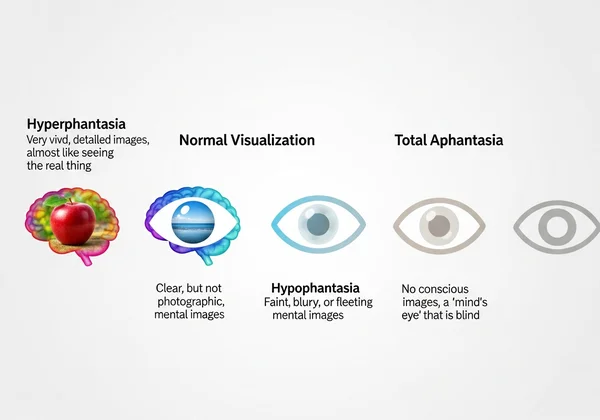
Aphantasia is the inability to voluntarily create mental images in your mind's eye. When someone says, "picture an apple," a person with aphantasia won't see an apple. Instead, they might know the concept of an apple—they know it's red or green, round, and has a stem—but they don't see a visual representation of it.
It's important to remember that aphantasia exists on a spectrum. Some people may have absolutely no visual imagery (total aphantasia), while others might see faint, dim, or fleeting images (hypophantasia). On the other end of the spectrum is hyperphantasia, where individuals experience extremely vivid and realistic mental imagery. This is a natural variation in human cognition, much like being left-handed or right-handed.
Recognizing Common Traits and Unique Strengths
While the primary trait of aphantasia is the lack of a mind's eye, it often comes with a set of unique cognitive strengths. Many people with aphantasia report that they are excellent conceptual thinkers. Because they don't get tied up in visual details, they can focus on abstract ideas, systems, and relationships between concepts.
For instance, instead of remembering visual snapshots, many report having a strong factual memory, recalling data and details with great accuracy. This often translates into powerful logical and analytical thinking, making them naturals in fields like programming and science. Some also find it easier to stay grounded in the present, free from a constant stream of mental images. Interestingly, some studies even suggest this can reduce the impact of traumatic imagery from past events.
Ed Catmull: A Visionary Leader Without Visual Imagery
Perhaps the most famous and inspiring example of a successful person with aphantasia is Dr. Ed Catmull. As the co-founder of Pixar Animation Studios and former president of Walt Disney Animation Studios, he has been a driving force behind some of the most visually stunning films ever created.
From Computer Science to Pixar: Catmull's Journey
Ed Catmull's story is fascinating because it directly challenges the assumption that visual creativity requires a visual mind's eye. With a Ph.D. in computer science, his goal was to create the first feature-length computer-animated film. He spent decades developing the technology that would eventually bring movies like Toy Story and Finding Nemo to life.
In his autobiography, Creativity, Inc., Catmull revealed that he has aphantasia. When he closes his eyes, he sees nothing but darkness. This revelation shocked many, as it seemed impossible for the head of Pixar—a studio synonymous with groundbreaking visuals—to lack mental imagery.
How Aphantasia Shaped His Innovative Approach
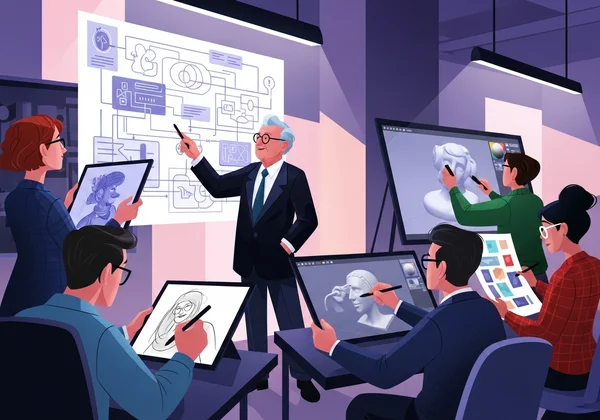
Instead of being a hindrance, Catmull’s aphantasia may have been a key to his success. Since he couldn't visualize the end product, he had to develop other ways to lead his team of artists and animators. His approach relied on abstract thinking and systems. He built a culture of open communication. This empowered his visual thinkers with a robust creative process.
He understood that his role wasn't to "see" the movie in his head, but to create an environment where others could bring their visions to life. His aphantasia allowed him to focus on the underlying structure of stories and the complex technical problems that needed solving, leaving the visual creation to the experts he trusted. This proves that leadership and vision are about more than just pictures.
More Accomplished Aphantasics: Diverse Fields, Unique Minds
Ed Catmull is not an isolated case. People with aphantasia are thriving in a wide range of professions, from technology and science to the arts. Their stories further demonstrate that there is no single "correct" way to think or create.
Artists, Writers, and Scientists Who Thrive Non-Visually
The list of accomplished aphantasics continues to grow as awareness spreads. Here are a few more examples:
- Blake Ross: The co-creator of the Firefox web browser, Ross is a brilliant software engineer who has publicly spoken about his aphantasia. His success relies on logical systems and abstract problem-solving, not visual mockups in his mind.
- Penn Jillette: The famous magician and entertainer from the duo Penn & Teller has also confirmed he has aphantasia. His creativity in designing illusions is conceptual and logical, proving that artistic performance doesn't always stem from a visual imagination.
- Glen Keane: A legendary Disney animator who worked on characters like Ariel, the Beast, and Aladdin. Glen Keane describes his internal world as 'blank.' He relies on feeling and motion, not full visuals. This unique style made his Disney characters iconic.
These individuals highlight how a non-visual mind can find alternative pathways to innovation and excellence.
Shared Strategies for Success in a Visual World
How do people with aphantasia succeed in a world that often prioritizes visual thinking? They develop powerful compensatory strategies. Many use external tools like sketching, note-taking, and physical models to organize their thoughts. They often excel at verbal communication, describing concepts with precision and clarity.
Collaboration is key too. Like Catmull, they team up with visual thinkers. Diverse minds create powerhouse results. If you think this might describe you, a great first step is to take a simple test to better understand your own mind.

Discover Your Mind's Eye: Free Aphantasia Test Insights
Reading these stories might have you questioning your own internal experiences. Do you see vivid pictures, faint outlines, or just concepts? Understanding your cognitive style is a journey of self-discovery that can be empowering and insightful.
The Science Behind Our Free Aphantasia Assessment
To help you on this journey, try our free aphantasia test—a quick, private self-assessment. Our test is inspired by established scientific principles used in cognitive research, such as the Vividness of Visual Imagery Questionnaire (VVIQ). It consists of a series of carefully designed questions that help you evaluate the vividness of your own mental imagery.
The process is simple, private, and takes only a few minutes. It's not a clinical diagnosis but a tool for self-reflection and exploration. Getting a baseline understanding of your mind's eye is the perfect starting point to better appreciate your unique strengths. Why not start your assessment now?

What Your Results Could Reveal About Your Cognition
After completing the questions, you will receive a score and a clear explanation of what it might mean. This can help validate your experiences and give you a new language to describe your inner world. For many, simply having a name for their experience—aphantasia—is a profound relief.
Want more? Our optional AI analysis delivers a personalized report. It uncovers your strengths and how you see the world.
Embrace Your Unique Mind's Eye: Take the Aphantasia Test Today
The success stories of people like Ed Catmull and Blake Ross prove that aphantasia is not a barrier to achievement. Instead, it is a different way of thinking that can foster unique strengths in logic, abstract reasoning, and conceptual creativity.
Your mind is your own, and understanding its unique wiring is the first step toward harnessing its full potential. Whether you have vivid mental imagery or a completely quiet mind's eye, your cognitive style is a valid and powerful part of who you are.
Ready to explore your inner world? Start your aphantasia test today and discover the unique landscape of your mind's eye.
Frequently Asked Questions About Aphantasia and Success
What are common traits of people with aphantasia?
Beyond the inability to visualize, common traits often include strong conceptual thinking, a good memory for facts and data, and logical problem-solving skills. Some also report differences in how they dream or recall memories.
Do people with aphantasia have an inner monologue?
Yes, most people with aphantasia report having a strong inner monologue. Aphantasia specifically relates to the lack of visual imagery. The internal experience of sound, dialogue, and conceptual thought (your inner voice) is a separate sensory process and is typically unaffected.
What are people with aphantasia good at?
People with aphantasia often excel in fields that rely on abstract thinking, logic, and data analysis, such as computer science, mathematics, engineering, and philosophy. However, as the examples show, their unique problem-solving skills can be an asset in any field, including the creative arts. To better understand your own cognitive profile, you can explore our test.
Is aphantasia neurodivergent?
Aphantasia is considered a form of cognitive diversity. While it's not a learning disability or a medical condition, it is a distinct variation in how the brain processes information, placing it under the broad umbrella of neurodiversity. It can co-occur with conditions like autism or ADHD, but it is not a type of either.