Can You Still Imagine Stuff Without Mental Imagery — Yes, Here's How
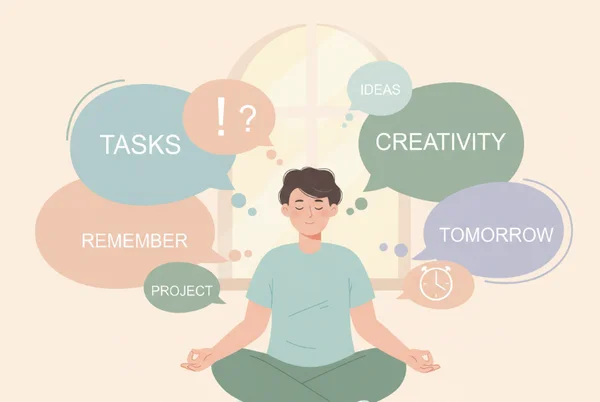
You close your eyes and try to picture a sunset. But nothing appears. No colors, no shapes — just a blank screen behind your eyelids. If this sounds familiar, you may wonder whether you can still imagine stuff without mental imagery at all. The short answer is yes. Mental imagery is just one way the brain imagines. Millions of people think, create, and dream without ever "seeing" pictures in their minds. This is often linked to a trait called aphantasia. In this guide, you'll learn what imagination actually looks like without mental images, how to recognize these patterns in yourself, and where you fall on the mental imagery spectrum. You'll also find self-reflection prompts and a way to explore your visual thinking style.
What Happens When Your Mind Can't Make Pictures
What Is Aphantasia and Why Does It Matter
Aphantasia is the term for an inability to voluntarily create mental images. When someone asks you to "picture a beach," most people see something — waves, sand, maybe a palm tree. However, if you experience aphantasia, your mind stays blank. You know what a beach looks like. You can describe it in detail. But you don't actually see it in your head.
This trait affects roughly 2% to 4% of the population. It's not a disease, a disorder, or a sign that something is wrong. Instead, it's simply a different way the brain processes imagination. The term was coined by Professor Adam Zeman in 2015, and research in this area continues to grow.
Why Mental Imagery Is Only One Part of Imagination
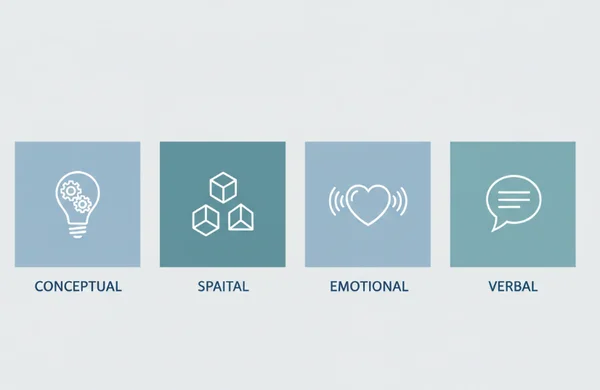
Here's the crucial point: imagination is not limited to pictures. When you imagine stuff without mental imagery, your brain uses other pathways. Think of it this way — imagination includes:
- Conceptual thinking: knowing facts, relationships, and attributes of things
- Spatial reasoning: understanding where things are in space without seeing them
- Emotional imagination: feeling what a situation would be like
- Verbal thinking: using inner speech and language to process ideas
So if you can't visualize a red apple, you still know it's round, smooth, and red. You can describe how it tastes. You understand what biting into one feels like. That's imagination — just without the picture.
How People Actually Think Without Visual Imagery
Thinking in Words, Concepts, and Facts Instead of Pictures
People who can't form mental images often rely on a rich inner monologue. When they think about a loved one, they don't see a face. Instead, they might recall facts — brown hair, kind smile, that specific laugh. Their memory works through associations and knowledge rather than replaying visual snapshots.
For example, if someone with aphantasia tries to remember their childhood home, they might think: "three bedrooms, blue front door, creaky staircase on the left." Every detail is accurate. But the experience feels more like reading a description than watching a video.
This style of thinking is perfectly effective. Many people go decades without realizing their experience differs from others. They simply assume everyone thinks this way.
How Non-Visual Thinkers Navigate Memory and Problem-Solving
Without mental imagery, people develop alternative strategies that work surprisingly well:
- Lists and verbal cues: organizing thoughts through words rather than pictures
- Pattern recognition: identifying logical patterns instead of visualizing outcomes
- Hands-on learning: preferring to do things physically rather than mentally rehearse them
- External tools: using notes, diagrams, and written plans more frequently
These approaches aren't limitations. In many cases, they lead to clear, focused, and efficient thinking. Some researchers suggest that non-visual thinkers may even have advantages in analytical and logical tasks because they process information without the "noise" of mental images.
Common Signs You Might Imagine Without Mental Images
Everyday Moments That Feel Different Without a Mind's Eye
You might experience aphantasia if certain situations feel noticeably different for you. Here are some common moments people describe:
- When someone says "picture this," you understand the concept but see nothing
- You struggle to describe what a friend looks like from memory, even though you'd recognize them instantly
- Reading fiction feels more like processing information than watching a movie in your head
- You find it difficult to recall visual details of past events, even important ones
- Counting sheep before sleep makes no sense because you can't "see" the sheep
These experiences don't mean anything is wrong. They simply reflect how your particular brain handles imagination.
A Quick Self-Reflection Checklist
Try this self-reflection exercise to explore your own imagery:
- Close your eyes and think about the face of someone you know well
- Try to "see" their eye color, hair, and expression
- Now think about your favorite place. Can you see any details, or do you just know what it looks like?
- Imagine biting into a lemon. Do you see the lemon, or just feel the sourness?
If you consistently know things without seeing them, you may be experiencing non-visual imagination. This is completely normal, and millions of people share this experience.
This checklist is for self-reflection purposes only. It is not a clinical assessment or diagnostic tool.
Can You Still Be Creative Without Seeing Pictures in Your Head
Why Creativity Doesn't Require a Mind's Eye
One of the biggest myths about aphantasia is that it kills creativity. This simply isn't true. Creativity is about generating ideas, making connections, and producing something new. Mental imagery can help with that, but it's far from the only path.
Many successful artists, writers, musicians, and designers have aphantasia or very low mental imagery. They create through:
- Iterative processes: building, adjusting, and refining work in real time
- Conceptual frameworks: working with abstract ideas and structures
- External references: using mood boards, reference images, and outlines
- Emotional intuition: letting feelings guide creative direction
In fact, some creatives find that the absence of strong imagery makes them more deliberate and intentional in their work.
How Non-Visual Thinkers Approach Creative Work
If you can't pre-visualize a painting, you might start with colors on a canvas and see what emerges. If you can't picture a character, you might develop them through dialogue and backstory. The creative process adapts to fit your cognitive style.
Aphantasia doesn't remove imagination. It changes the format. The ideas are still there. They just arrive as concepts, feelings, and words instead of pictures.
Why Some People Dream in Pictures But Can't Imagine Them Awake
The Difference Between Voluntary and Involuntary Imagery
Here's something that surprises many people: you can have aphantasia and still dream in vivid images. How is this possible?
The answer lies in the difference between voluntary and involuntary imagery:
- Voluntary imagery is when you deliberately try to picture something. This is what's affected by aphantasia.
- Involuntary imagery includes dreams, flashbacks, and sudden mental flashes. These use different neural pathways and may remain fully intact.
So your brain may be perfectly capable of generating images. It just doesn't do so when you consciously try. This distinction is important because it shows that the visual processing hardware isn't broken — the voluntary "on switch" simply works differently.
What Dreams Reveal About How Your Brain Processes Images
Research suggests that dreaming bypasses the usual conscious control systems. During REM sleep, your brain activates visual areas without needing a deliberate command. This explains why many people with aphantasia report vivid, colorful, and detailed dreams.
However, some people with aphantasia report reduced or absent dream imagery as well. This confirms that aphantasia exists on a spectrum, and no two experiences are exactly alike.
Where You Fall on the Mental Imagery Spectrum
From Aphantasia to Hyperphantasia — Understanding the Range
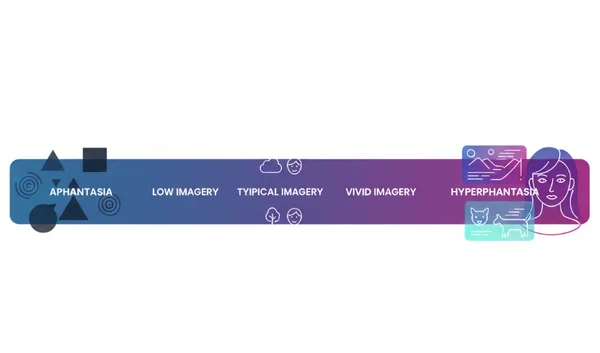
Mental imagery isn't an all-or-nothing ability. It exists on a spectrum:
| Level | Experience |
|---|---|
| Aphantasia | No voluntary mental images at all |
| Hypophantasia | Dim, vague, or fleeting images |
| Typical imagery | Moderately clear mental pictures |
| Hyperphantasia | Extremely vivid, lifelike imagery |
Most people fall somewhere in the middle. You might see vague outlines, or you might experience something closer to one end. Understanding where you sit helps you make sense of your own thinking patterns.
How the VVIQ Helps Map Your Visual Imagination
The Vividness of Visual Imagery Questionnaire (VVIQ) is one of the most widely used tools for measuring imagery strength. It asks you to imagine specific scenes and rate how vivid they appear on a scale.
The VVIQ isn't a diagnostic test. It's a self-reflection framework that helps you understand your imagery tendencies. Researchers use it in studies on aphantasia, and it can be a helpful starting point if you're curious about your own experience.
How to Explore Your Own Imagination Style
Why Self-Reflection Is a Helpful Next Step
Now that you understand how imagination works without mental imagery, you might be wondering where you personally fall on the spectrum. Self-reflection is a great place to start.
Pay attention to how you think in everyday situations. When you recall a memory, do you see it, feel it, or narrate it? When you plan your day, do you visualize a schedule or think through a verbal list? There's no right or wrong answer.
If you want a more structured way to explore your imagery, tools based on the VVIQ framework can help you organize your observations. The goal isn't to label yourself. It's to understand your own cognitive patterns better.
What You Can Learn From a Visual Imagery Assessment
A visual imagery assessment can help you:
- Understand whether your imagery is typical, low, or absent
- See how your experience compares to the general population
- Gain vocabulary to describe your thinking style to others
- Identify strengths associated with your particular cognitive approach
If you're curious, you can discover how your mind's eye works through a brief, science-informed reflection exercise. It's free, private, and designed to help you understand — not diagnose.
This tool is designed for self-understanding and educational exploration. It does not replace professional evaluation or clinical assessment.
Embracing How Your Mind Imagines
The question "can you still imagine stuff without mental imagery" has a clear answer: absolutely yes. Imagination is much broader than mental pictures alone. Whether you think in words, concepts, emotions, or spatial reasoning, your ability to imagine is real and valid.
Here are the key takeaways:
- Aphantasia is a natural cognitive variation, not a disorder
- You can be fully creative, productive, and emotionally rich without mental imagery
- Mental imagery exists on a spectrum, and your position on it is unique to you
- Self-reflection tools can help you understand your thinking patterns better
If you're curious about your own imagery, take a moment to explore your thinking style with a visual imagery assessment. And if your lack of imagery causes distress or affects your daily life, consider speaking with a psychologist or cognitive specialist who understands these differences.
Your mind works differently — and that's something worth understanding, not fixing.
Frequently Asked Questions
What is it called when you can't picture things in your mind?
The term is aphantasia. It describes the inability to voluntarily create mental images. People with aphantasia can still think, remember, and imagine, but they do so without visual pictures in their mind's eye.
Is aphantasia a disability or a disorder?
No. Aphantasia is considered a cognitive variation rather than a medical condition. It does not impair intelligence, memory, or daily functioning. Most people with aphantasia live normally without any need for treatment.
How rare is aphantasia?
Research estimates that roughly 2% to 4% of the population experiences aphantasia. However, because many people don't realize their imagery differs from others, the actual number may be higher.
Does aphantasia affect memory or emotions?
Aphantasia may change how you experience memories, as recall tends to be more fact-based than visual. However, emotional memory and overall emotional depth remain intact. People with aphantasia still feel deeply.
Can your ability to visualize change over time?
In some cases, yes. Some people report changes in imagery vividness due to meditation, aging, or neurological events. However, most people's imagery ability stays relatively stable throughout their lives.
When might it help to speak with a professional about your thinking style?
Consider reaching out to a psychologist or cognitive specialist if your lack of imagery causes significant distress, affects your work or relationships, or if you want a deeper understanding of your cognitive profile. A professional can provide personalized guidance.