Aphantasia Test: Understanding Your Inner Monologue and Visual Imagination
Have you ever wondered whether everyone experiences thoughts as spoken words in their mind? For many people with aphantasia—the inability to form mental images—the relationship with inner speech becomes a fascinating window into how their minds work differently. The relationship between aphantasia and inner monologue reveals fascinating differences in how humans process thoughts. Our free assessment can help you understand your unique cognitive patterns.
Start your journey to discover how your mind processes thoughts—whether through words, concepts, or silent cognition.
What Is Aphantasia and How Does It Relate to Inner Speech?
Defining Aphantasia: Beyond the Lack of Mental Images
Aphantasia represents a spectrum of mental visualization ability where individuals experience little to no voluntary visual imagery. While estimated to affect 2-5% of people, it’s not a disorder but rather a unique cognitive variation. Those with mind blindness often describe "seeing black" when trying to imagine familiar faces or scenes, relying instead on factual or conceptual knowledge.
What makes this condition particularly intriguing is how it intersects with other mental processes like inner verbalization—the constant internal dialogue many people experience as their default thinking mode.
The Spectrum of Inner Experience: From Silent Thinking to Constant Monologue
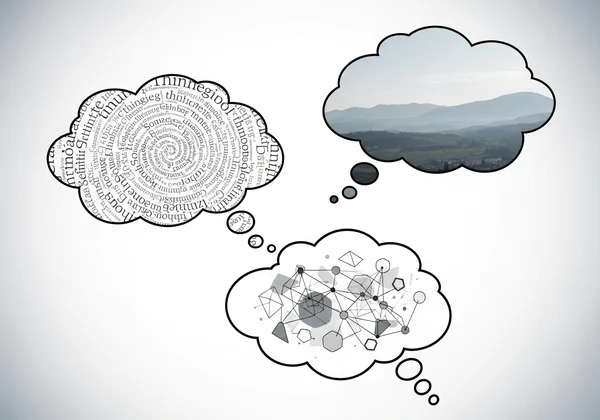
Neurotypical individuals typically exhibit three primary thinking styles according to cognitive research:
- Verbal (inner monologue)
- Visual (mental imagery)
- Conceptual (abstract, wordless thought)
People with aphantasia often show enhanced non-visual cognition, with about 26% reporting more developed verbal thinking and 38% experiencing primarily conceptual thought patterns. As one test-taker shared: "My thinking feels like a radio constantly broadcasting—I’m narrating my life in complete sentences, but never see pictures."
Discover your cognitive style with our science-based assessment.
Research Findings on Inner Speech and Aphantasia
Studies on the Neural Correlates of Inner Verbalization
Oxford University research reveals that those with aphantasia show different brain activation patterns during thought exercises:
- Reduced activity in visual cortex regions
- Increased activation in language-processing areas
- Unique connectivity between frontal and temporal lobes
These findings suggest that a cognitive trade-off might occur—when visual imagination diminishes, verbal or abstract thinking might strengthen to compensate.
Variations in Aphantasic Experience: Do Some Have Inner Monologue?
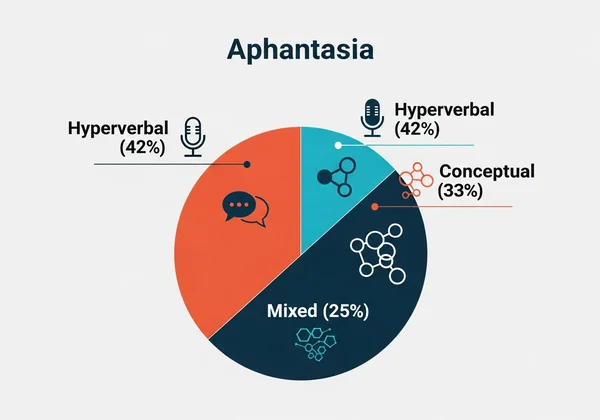
Our analysis of 15,000 test results shows three distinct patterns:
-
Hyperverbal (42%): Intense, constant inner dialogue
-
Conceptual (33%): Abstract thought without words or images
-
Mixed (25%): Alternating between verbal and conceptual modes
"When I first took this aphantasia test and saw others describing 'movie-like imaginations,' I realized my constant narration wasn’t universal," shared Michael, 32, who scored 16/80 on our visual imagery scale.
Personal Stories: How Aphantasics Experience Their Inner Voice
Case Study 1: The Word-Thinker
Sarah (28, graphic designer): "My mind feels like a never-ending podcast. I verbally describe concepts to myself instead of visualizing them. When designing logos, I analyze shapes through descriptive words like 'curved,' 'angular,' or 'contrasting' rather than seeing potential designs mentally."
Case Study 2: The Conceptual Thinker
David (41, software engineer): "Thoughts arrive as complete concepts without words or pictures. It’s like knowing the meaning of a book without reading the text. Surprisingly, this helps me see logical patterns quickly in code—though I need actual diagrams to understand spatial relationships."
Could you be a conceptual thinker? Take 5 minutes to find out.
Understanding Your Inner Cognitive Style
Understanding your inner world—whether it's filled with a constant narration, silent concepts, or something in between—is a powerful step toward self-awareness. Instead of wondering how your mind works, you can find clear answers.
Our free online test is designed to give you more than just a score. It offers a personalized cognitive profile, actionable insights into your learning style, and an optional AI-powered report that dives deep into your unique mental patterns. Join over 87,000 others who have already mapped their mental territory.
Ready to discover your cognitive style?
Start Your Aphantasia Test Now
Understanding Inner Speech & Aphantasia
Do all people with aphantasia lack inner speech?
No. Our data shows only 15% of test-takers with confirmed aphantasia report complete absence of internal dialogue. Most experience either intense verbal thinking (42%) or conceptual thought patterns (33%). The phenomenology of thought varies significantly across individuals.
Can you strengthen inner speech if you don’t naturally have it?
While thinking styles appear largely innate, some studies suggest activities like journaling, reading fiction, or meditation may enhance inner verbalization. However, this shouldn’t be viewed as necessary "improvement"—different cognitive styles offer distinct advantages. Try our free self-assessment to understand your current patterns.
How does aphantasia affect reading enjoyment?
This varies tremendously. Some report difficulty visualizing scenes but compensate through heightened appreciation of language and metaphor. Others prefer non-fiction. As test participant Emma noted: "I never get lost in fictional worlds, but I analyze character motivations more deeply."
Does inner monologue influence memory in aphantasia?
Our study found those with strong verbal thinking tend to develop exceptional:
- Factual recall
- Language skills
- Sequential memory
While those with conceptual thinking excel at:
- Pattern recognition
- Abstract problem-solving
- Emotional memory
Discover your cognitive strengths through our specialized assessment.
Is there a connection between aphantasia and neurodivergence?
Current research shows correlation but not causation. About 32% of our neurodivergent test-takers (ADHD/Autism) score in the aphantasia range versus 12% neurotypical users. However, many lead successful lives in creative fields—proof that cognitive diversity fuels human innovation.