Aphantasia Test Guide: Memory Hacks & Study Strategies for Non-Visual Thinkers
Do you find it frustrating when teachers or colleagues say, "just picture it in your mind"? For many students and professionals with aphantasia, traditional study methods that rely on visualization simply don't work. If you've ever struggled to create mental images while studying or wondered why your memory works differently from others, you're not alone. The first step to understanding your unique cognitive style is often confirming it, which you can explore with an online aphantasia test.
This guide explores evidence-based learning strategies specifically designed for non-visual thinkers. We will look at practical memory hacks and study tips that play to your strengths, helping you unlock your full cognitive potential without needing a mind's eye.
Understanding Your Aphantasic Learning Style
To succeed, you first need to understand how your brain works. An aphantasic learning style isn't a disadvantage; it's simply a different way of processing the world. By recognizing this, you can stop trying to force visual techniques and start using methods that align with your natural abilities.
How Aphantasia Impacts Information Processing
Aphantasia is the inability to voluntarily create mental images. When someone with aphantasia is asked to imagine an apple, they won't see a picture in their mind. They might understand what an apple is conceptually—its color, shape, and taste—but the visual image simply isn't there.
This can impact learning in several ways. Rote memorization that relies on "photographic memory" or creating mental "mind palaces" can be challenging. Following complex visual descriptions without a real-world reference can also be difficult. However, many people with aphantasia develop highly advanced skills in other areas, such as verbal, conceptual, and logical reasoning, to compensate.
The Science Behind Non-Visual Memory Systems
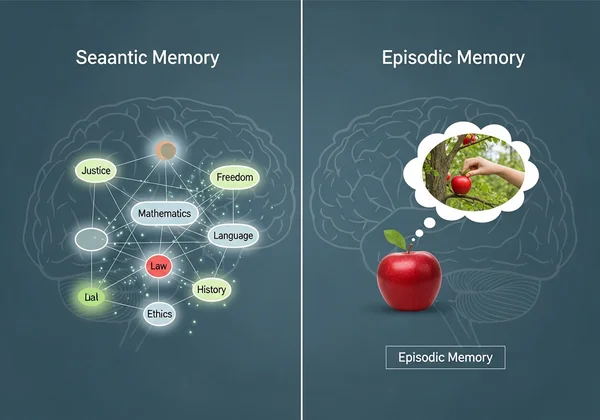
Cognitive science reveals that memory isn't a single system but a network of different types. While visual memory (iconic memory) is powerful for many, it's not the only way to learn. People with aphantasia often have strong semantic memory, which deals with concepts, facts, and knowledge about the world. They also rely heavily on verbal and kinesthetic (movement-based) memory.
Instead of seeing a diagram of a historical battle, a non-visual learner might remember the sequence of events as a story or a list of logical cause-and-effect relationships. This is just as effective; it just uses a different neural pathway. Understanding this science helps validate your experience and empowers you to find strategies that work for you. To better understand your own memory system, consider taking a free aphantasia test.
Evidence-Based Learning Strategies for Aphantasics
Once you understand your learning style, you can adopt proven strategies that don't depend on mental imagery. These techniques leverage verbal, spatial, and technological tools to help you learn and retain information effectively.
Verbal and Conceptual Learning Techniques
For many with aphantasia, words are the primary tool for thinking and remembering. Lean into this strength with the following techniques:
- The Feynman Technique: Explain a complex topic out loud in simple terms, as if you were teaching it to a child. This forces your brain to connect concepts logically rather than visually.
- Create Detailed Outlines: Structure information hierarchically. Use headings, subheadings, and bullet points to organize facts and their relationships. This builds a conceptual map instead of a visual one.
- Use Acronyms and Mnemonics: Create memorable phrases or words to recall lists. For example, "My Very Educated Mother Just Served Us Noodles" helps remember the planets.
- Record and Re-listen: Record lectures or yourself reading notes. Auditory repetition can be a powerful tool for reinforcing memory when visual recall isn't an option.
Spatial and Tactile Memory Enhancement
Your brain can remember things through physical sensation and spatial relationships, even without mental pictures.
- Pacing and Reciting: Walk around the room while reciting facts. The physical movement can help link information to a kinesthetic experience, making it easier to recall.
- Mind Mapping on Paper: While you can't create a mind map in your head, you can draw one physically. Use colors, lines, and boxes to connect ideas on a large sheet of paper. The act of creating it and seeing the spatial layout can aid memory.
- Use Physical Objects: For abstract concepts, use coins, blocks, or other small objects to represent different elements. Manipulating them physically can help you understand and remember their relationships.
Leveraging Technology for Visual Support
You don't need to create images in your mind when technology can create them for you in the real world.
-
Find or Create Infographics: Use tools like Canva to turn notes into simple, visually organized infographics. This externalizes the "mental image" so you can refer to it.
-
Watch Explanatory Videos: Platforms like YouTube and Khan Academy are excellent resources. Seeing an animation of a biological process is often more helpful than trying to visualize it from a textbook description.
-
Use Digital Flashcards: Apps like Anki or Quizlet allow you to create flashcards with text, sounds, and real images. This provides the external visual cue your mind doesn't produce internally.

Professional Success with Aphantasia
These learning strategies aren't just for school; they are powerful tools for career growth. Many successful professionals have aphantasia and have learned to leverage their unique cognitive strengths in the workplace.
Workplace Accommodations for Non-Visual Thinkers
In a professional setting, being clear about your needs can make a huge difference. You can ask for simple accommodations that support your thinking style:
- Request written summaries or meeting minutes instead of relying on verbal descriptions.
- Ask for diagrams, flowcharts, or prototypes during project discussions.
- Use note-taking apps and task managers to keep your conceptual frameworks organized.
- When brainstorming, use a physical whiteboard to map out ideas instead of trying to hold them all in your head.
Career Paths Suited to Aphantasic Strengths
Many people with aphantasia excel in fields that rely on logic, systems thinking, abstract reasoning, and verbal skills. While anyone can succeed in any field, some careers that naturally align with these strengths include:
- Computer Science and Programming: Focuses on logic, systems, and abstract structures.
- Mathematics and Engineering: Relies on understanding formulas and principles.
- Writing and Editing: A strength for those with a strong inner monologue and command of language.
- Law and Philosophy: Requires rigorous logical reasoning and conceptual analysis.
Remember, aphantasia doesn't limit your potential. It simply means you approach problems from a different, often highly analytical, perspective.
Your Adaptive Learning Journey Begins Now
Aphantasia isn't a learning barrier—it's just a different way of processing information. When you match your study methods to how your brain actually works, you'll discover strengths you never knew you had. The key is to understand your mind and use tools that support its natural abilities.
Are you ready to explore your mind's eye and unlock your learning potential? The first step is gaining clarity about your own visual imagination. Our scientifically-inspired assessment can provide valuable insights into your cognitive profile.
Start your aphantasia test now to begin your journey of self-discovery.

The Takeaway
Can I still be successful in school or my career with aphantasia?
Absolutely. Many highly successful individuals, including Ed Catmull (co-founder of Pixar) and Blake Ross (co-creator of Firefox), have aphantasia. Success depends on adapting and using your unique strengths, such as abstract thinking and logical reasoning, rather than trying to force a visual approach.
Are certain learning methods more effective for aphantasics?
Yes. Methods that rely on verbal processing, logical structuring, and physical interaction tend to be more effective. Techniques like the Feynman Technique (explaining concepts aloud), creating detailed outlines, and using physical mind maps are excellent alternatives to visualization-based learning.
How can I tell if my learning challenges are due to aphantasia?
If you consistently struggle with tasks that require mental imagery (like imagining a friend's face) and find that visual learning tips don't work for you, aphantasia might be a factor. The best way to explore this is by taking a self-assessment designed to measure the vividness of visual imagery. A simple aphantasia test can give you a clearer picture.
Do these strategies work for children with aphantasia?
Yes, many of these principles can be adapted for younger learners. Using physical blocks for math, drawing out story concepts, and encouraging kids to talk through problems are all effective methods. Identifying a non-visual learning style early can help parents and educators provide the right support for a child's academic journey.