Aphantasia Test: Do People with Aphantasia Have an Inner Monologue?
Have you ever tried to picture an apple in your mind and come up with... nothing? If you find that your thoughts are more like concepts or words than pictures, you might have wondered about the inner workings of your mind. This leads to a fascinating question that many people explore: Do people with aphantasia have an inner monologue? The answer is more complex and interesting than a simple yes or no.
This article delves into the captivating relationship between the aphantasia inner monologue and the diverse ways we think. We’ll explore how a mind without pictures processes information, communicates with itself, and navigates the world. Your cognitive style is a unique blueprint, and understanding it is the first step toward appreciating its inherent strengths. If you're ready to begin this journey of self-discovery, you can start your assessment now.
Unpacking the Inner Monologue: Is There a Link to Aphantasia?
The connection between aphantasia—the inability to voluntarily create mental images—and the inner monologue is often a source of confusion. Many assume that if one sensory experience is absent, others might be too. However, these two cognitive functions are largely independent. Aphantasia relates to the mind's eye, while the inner monologue relates to the mind's ear or voice.
Understanding this distinction is key to appreciating the rich diversity of human consciousness. Just because you don't think in pictures doesn't mean your internal world is silent. For many, it's a vibrant space filled with words, concepts, and feelings.
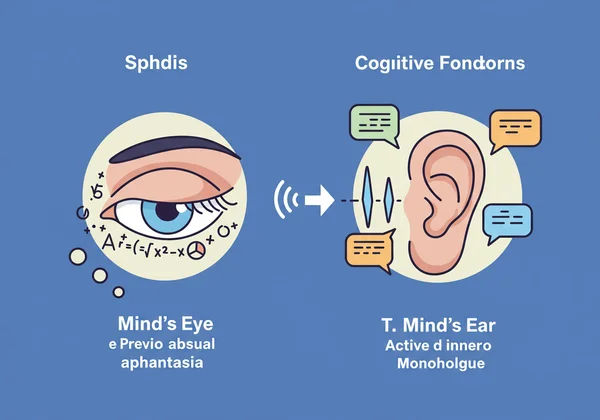
What is an Inner Monologue, Really? Defining Your Internal Voice
An inner monologue is the voice inside your head that narrates your thoughts, debates decisions, or rehearses conversations. It's the silent speech you use to process information and make sense of the world. For some, this voice is constant and clear, almost like listening to a running commentary. For others, it’s more sporadic, appearing only during deep concentration or problem-solving.
This internal voice is a distinct neurological process from visual imagination. It engages different parts of the brain, primarily those associated with language production and comprehension. Therefore, the presence or absence of a vivid inner monologue isn't directly tied to whether you can visualize a sunset or a loved one's face.
Aphantasia: A Spectrum of Internal Experience Beyond Visuals
It's crucial to remember that aphantasia exists on a spectrum. Some people have absolutely no mental imagery (total aphantasia), while others have faint, fleeting, or dim images. This condition specifically affects the visual component of imagination. It doesn't typically impact other senses like internal hearing, touch, taste, or smell, though some individuals may experience a broader lack of sensory imagination.
Most people with aphantasia report having a robust inner monologue. Their thoughts unfold in words, sentences, and structured language. Instead of "seeing" a to-do list, they might "hear" themselves listing the tasks. This verbal thinking becomes their primary tool for memory, planning, and reflection, proving that a rich inner life doesn't depend on pictures. To see where you fall on the spectrum, a visual imagery test can provide valuable insights.
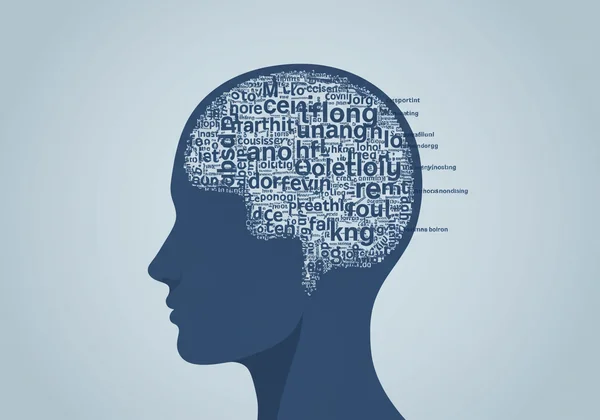
Beyond Words & Pictures: The Diverse Ways Aphantasics Think
If some people with aphantasia don't have a strong inner monologue, how do they think? The human mind is incredibly adaptive, developing multiple pathways for processing information. For those who don't rely on pictures or a constant internal narrator, thought can take other fascinating forms.
This is where concepts like abstract and unsymbolized thinking come into play. These cognitive styles allow individuals to understand and manipulate complex information without needing to translate it into sensory data first. It’s a pure, direct form of knowing.
Understanding Unsymbolized Thought: Processing Without Sensory Imagery
Unsymbolized thinking is the experience of a thought without any accompanying words, pictures, or other sensory components. It's a direct awareness of a concept. For instance, you might suddenly "know" the solution to a problem without having "seen" or "heard" the steps in your head. You simply grasp the idea in its purest form.
Many people with aphantasia are masters of this cognitive style. Their thinking is highly conceptual and abstract. They can work with data, logic, and systems intuitively because their minds aren't busy rendering sensory details. This mode of thought is efficient and powerful, though it can sometimes be difficult to describe to someone whose thinking is predominantly sensory.

Navigating the World with Non-Visual Cognition: Practical Examples
How does non-visual thinking manifest in daily life? Instead of visualizing the route to a new location, a person with aphantasia might remember it as a list of sequential directions: "turn left at the big oak tree, go three blocks, turn right at the post office."
When recalling a memory, they might not see a replay of the event but will remember the facts, the emotions they felt, and the sequence of what happened. They know who was there and what was said, all stored as semantic or conceptual information rather than a visual movie. This demonstrates how the brain develops powerful alternative strategies to navigate, remember, and create. Discovering your own cognitive patterns is a fascinating journey, and an aphantasia self-assessment is a great place to start.
Valuing Your Unique Cognitive Blueprint: Strengths of Non-Visual Minds
For too long, aphantasia has been discussed in terms of what it lacks. It’s time to shift the perspective and focus on what this unique cognitive style offers. A mind that isn't occupied with generating images can excel in areas that require abstract thinking, objectivity, and a focus on essential information.
Embracing your neurodiversity means recognizing that your way of thinking isn't a deficit; it's a difference with its own set of advantages. Many successful scientists, engineers, and philosophers have reported having aphantasia, using their unique minds to achieve incredible things.
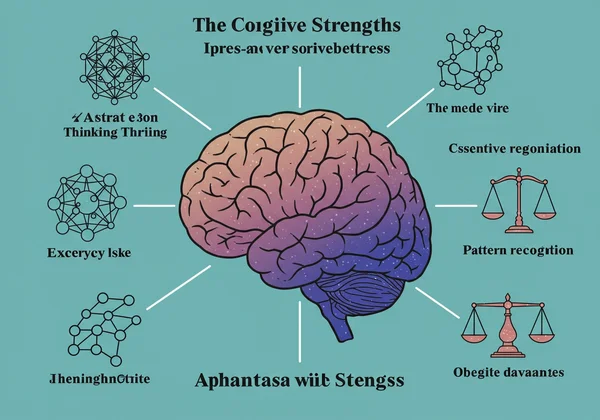
Cognitive Strengths: How Aphantasia Can Be an Advantage
Living without a mind’s eye can foster some remarkable strengths. Aphantasics often report being more present in the moment, as they aren't distracted by daydreams or intrusive mental images. They may also be less susceptible to trauma-related flashbacks, as the painful memories aren't replayed visually.
Furthermore, aphantasic thinking can be a powerful asset in professional fields that demand logical and abstract reasoning. People with aphantasia often excel at recognizing patterns, thinking in systems, and processing factual information without being swayed by visual bias. Their ability to think conceptually allows them to cut straight to the core of a problem.
Embracing Your Aphantasic Mind: Self-Acceptance & Continued Discovery
Understanding that you think differently is a profound moment of self-awareness. It's an invitation to explore your mind's unique operating system and learn to leverage its strengths. Aphantasia isn't something to be fixed; it's a part of your cognitive identity.
The journey doesn't end with a label. It begins with it. By continuing to explore your cognitive traits, you can develop personalized strategies for learning, creativity, and problem-solving that align with how your brain naturally works. This path of self-acceptance and discovery is empowering and can lead to a deeper appreciation for the incredible diversity of the human mind. If you’re curious to learn more, take the aphantasia test.
Embracing Your Cognitive Blueprint: Further Exploration Awaits
The relationship between aphantasia and the inner monologue is a perfect example of neurodiversity. There is no single "correct" way to think. Whether your mind is a canvas for vivid imagery, a stage for a constant narrator, a silent space of pure concepts, or a combination of all three, it is uniquely yours. Understanding your internal world is the key to unlocking your full potential.
If you've recognized parts of your own experience in this article, your journey of discovery has just begun. The next step is to gain a clearer picture of your specific cognitive profile. Our science-inspired assessment can help you quantify your experience and provide a foundation for deeper understanding.
Are you ready to explore your mind's eye? Try our free tool today and uncover the unique way you see—or don't see—the world.
Frequently Asked Questions About Aphantasia and Thought
Do people with aphantasia have an inner monologue?
Yes, most people with aphantasia report having a normal or even highly active inner monologue. Aphantasia affects the ability to create voluntary mental images, which is a separate cognitive process from the internal "voice" associated with language and thought.
What are common traits of people with aphantasia?
Common traits include difficulty recognizing faces (prosopagnosia), challenges with recalling visual details from memory, and a preference for conceptual or factual information over descriptive details. However, many also report strong skills in abstract thinking, logic, and mathematics. The best way to understand your own traits is with a structured mind blindness test.
How do people with aphantasia remember things without pictures?
People with aphantasia rely on other forms of memory, such as semantic memory (facts and concepts), procedural memory (how to do things), and autobiographical memory based on factual recall. They remember what happened, who was there, and how they felt, but without a visual replay of the event.
Is unsymbolized thinking common among aphantasics?
While not exclusive to aphantasia, unsymbolized thinking—the experience of thought without words or images—appears to be a common and highly developed skill among many aphantasics. It allows for rapid, direct, and abstract processing of information, which can be a significant cognitive advantage.