Aphantasia Red Star Test: What It Can and Cannot Tell You
The aphantasia red star test is a quick way to notice how your mind handles visual imagery. You close your eyes, imagine a red five-pointed star, and ask yourself whether you actually see anything, sense something vague, or simply know what a red star is. That tiny exercise can be surprisingly revealing, especially if you have always assumed "picture it" was only a figure of speech. Still, the red star test is best treated as a conversation starter, not a final answer. For a gentler way to compare your experience with a structured imagery scale, AphantasiaTest.com offers a visual imagery self-check that treats results as reflection, not a verdict.
What the Red Star Test Is Really Asking
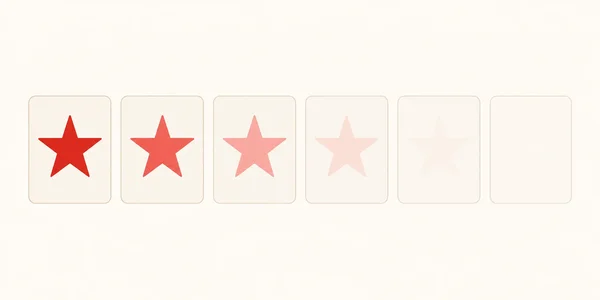
The red star test for aphantasia asks a narrow but useful question: when you intentionally try to form a simple visual image, do you experience an image-like quality? The object is simple on purpose. A red star has a clear shape, a clear color, and few details. If someone can visualize easily, they may report a crisp star, a dim star, a flickering outline, or a color patch. If someone has very low voluntary visual imagery, they may report no image at all while still understanding the idea perfectly.
That distinction matters. Knowing is not the same as seeing. You can know that a star has five points, know that it is red, and even reason about how it would look on paper without any mental picture appearing. Many people with aphantasia describe this as conceptual thinking: the information is present, but not as a visual scene.
The test also highlights that mental imagery is a spectrum. Some people experience vivid, stable images. Some experience dim, brief, or partial images. Some experience almost nothing visually but may imagine sounds, movement, touch, emotion, or spatial layouts in other ways. The red star test does not capture all of that complexity, but it can help you notice where your visual experience may sit.
How to Try the Red Star Test Without Overreading It
Use the test in a calm setting, without trying to force a result. Close your eyes if that feels natural, then think of a red five-pointed star for about ten seconds. Afterward, ask what was present in your awareness.
A simple 60-second reflection
- Did you see a star-like image, or did you mainly think about the idea of a star?
- If there was an image, was it vivid, moderate, dim, brief, or unstable?
- Could you sense color, outline, location, or movement?
- Did the image feel voluntary, or did it appear only for a moment without much control?
- Would your answer change if your eyes were open, or if you used a familiar object instead?
Try the same exercise another day with an apple, a window, or a familiar room. If your answers are consistent, they may tell you more than one rushed attempt. If your answers change, that is useful too. Tiredness, stress, attention, and how concrete the object feels can all affect introspection.
What Different Answers May Mean on the Imagery Spectrum
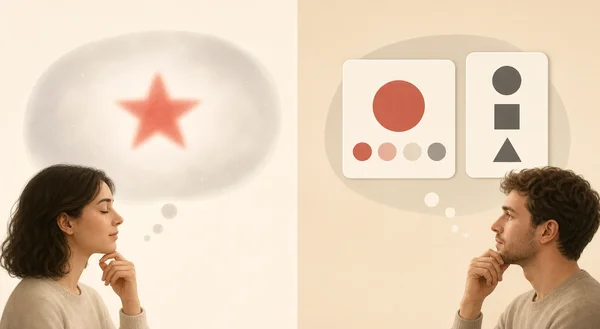
If you see a vivid star, you probably have accessible voluntary visual imagery for simple objects. That does not mean every imagined scene is equally vivid; people can be strong with objects and weaker with faces, places, or moving scenes.
If you see a hazy or partial star, you may be somewhere in the middle of the imagery spectrum. You might form a faint outline but lose the color, or sense red without a stable shape. This is common and does not automatically point to a problem.
If you see no star at all, but you know exactly what you are trying to imagine, your experience may resemble aphantasia. People often describe this as a blank inner screen, image-free thinking, or the absence of a mind's-eye picture. The key is not whether you understand the prompt. The key is whether an image-like experience appears when you voluntarily try to create one.
It is also possible to have mixed experiences. Some people report no voluntary images but still dream visually. Others notice spontaneous flashes but cannot summon images on command. Some can work with spatial layouts without seeing color or texture. The red star test is useful because it opens the door to those distinctions, not because it reduces them to one score.
Why the Red Star Test Is Not the Same as VVIQ
The red star test is informal. It is fast, memorable, and easy to discuss, but it uses one object and one moment of self-report. A VVIQ-style questionnaire is broader because it asks about multiple scenes and features, such as color, shape, clarity, and vividness across several imagined situations. That structure can make reflection more consistent.
If the red star test leaves you curious, a VVIQ-style imagery reflection can give you a more rounded view of your visual imagery pattern. Even then, online self-assessment should be understood as educational. It can help you name an experience, compare patterns, and prepare better questions, but it should not be treated as a clinical conclusion.
The red star test can also be affected by wording. Some people interpret "see" as literally seeing with the eyes. Others use "see" to mean a faint inner impression. Some people rate themselves low because their image is not photo-realistic, even though they do have visual imagery. Others rate themselves higher because they know details conceptually and mistake that knowledge for seeing. Slow, precise reflection helps reduce those mix-ups.

Common Misreadings: Nothing, Knowing, and Seeing
One common misreading is assuming that "nothing" means a lack of imagination. Aphantasia is about visual imagery, not the whole imaginative mind. People can think creatively, solve design problems, write stories, remember facts, enjoy fiction, or plan future events without inner pictures. Many rely on language, logic, emotion, bodily feeling, sound, or spatial understanding instead.
Another misreading is assuming that a red star score maps neatly onto all of daily life. Memory, reading, navigation, art, and emotional reflection can all work in different ways. Someone may not picture a friend's face when they are away, yet still recognize that friend instantly in person. Someone may not visualize a scene while reading, yet still enjoy plot, voice, theme, and feeling.
A third misreading is treating a single internet scale as proof that something is wrong. Aphantasia is often discussed as a cognitive difference, not as a flaw. If you were born with very low imagery, it may simply be your ordinary way of thinking. If your imagery changes suddenly, especially after an injury or major health event, that is a different situation and is worth discussing with a qualified professional.
Is Aphantasia Real, Rare, or Bad?
Aphantasia is real in the sense that many people consistently report little or no voluntary visual imagery, and research has found meaningful differences between low-imagery and vivid-imagery groups on some imagery-related tasks. It is also relatively uncommon, though estimates vary because researchers use different definitions and cutoffs. Many summaries place very low visual imagery in the low single digits of the population, while broader self-report methods can produce higher numbers.
The more personal question is whether aphantasia is bad. For many people, no. It may feel surprising to discover, and some people need time to reinterpret memory, reading, daydreaming, or relationships. But a different imagery style is not the same as a broken mind. It can come with tradeoffs: some visual recall may feel less rich, while conceptual, verbal, or spatial strategies may be strong.
Related searches often connect aphantasia with ADHD, autism, intelligence, and symptoms. It is fair to be curious, but the safest framing is cautious. Some studies explore associations with other traits, yet associations do not prove cause, identity, or outcome for an individual person. A red star exercise cannot answer those broader questions by itself.
Using the Aphantasia Red Star Test as a Starting Point
The best use of the aphantasia red star test is not to label yourself quickly. It is to notice your own inner language more carefully. After the exercise, write a few sentences about what happened. Did you see, know, feel, remember, or reason? Did the answer surprise you? Did you compare your experience with someone else's and realize you had been using the same words for different inner events?
From there, you can explore more patiently. Try a structured reflection, read about the imagery spectrum, or compare visual imagination with other forms of inner experience. If you want a gentle next step, the mind's-eye self-exploration tool can help you organize those observations without turning them into a high-pressure judgment.
Most importantly, let the red star test make you curious rather than worried. Whether your mind produces a bright star, a faint outline, or no picture at all, you still have ways to imagine, remember, create, and understand. The useful question is not "What is wrong with me?" It is "How does my mind represent information, and what strategies fit that style?"
FAQ
What is the red star test?
The red star test is an informal imagery exercise. You close your eyes, imagine a red five-pointed star, and reflect on whether you see a vivid image, a faint image, or no image-like experience. It is popular because it makes visual imagery differences easy to discuss.
Is the red star test for aphantasia reliable?
It can be useful as a first reflection, but it is not a full assessment. It uses one prompt and depends on self-report. A broader questionnaire can ask about multiple scenes and help you compare your answers more consistently.
What does it mean if I see nothing?
Seeing nothing may mean your voluntary visual imagery is very low, especially if this happens across many prompts. It does not mean you lack imagination or creativity. You may represent information through words, concepts, feelings, sound, or spatial awareness instead.
Is aphantasia actually rare?
Aphantasia appears to be uncommon, but estimates vary. Research summaries often place very low visual imagery in the low single digits of the population, while broader self-report questions can produce different numbers. Many people do not notice the difference until later in life.
Is aphantasia linked to high IQ?
There is no simple rule connecting aphantasia with high or low IQ. People with aphantasia can have many different strengths, careers, learning styles, and creative habits. Imagery vividness is only one part of cognition.
What are the signs of hyperphantasia?
Hyperphantasia is usually described as unusually vivid mental imagery. A person may picture scenes with strong color, detail, stability, and realism. Like aphantasia, it sits on a broader imagery spectrum, so everyday experiences can vary.
Is aphantasia bad?
For many people, aphantasia is not bad; it is a different cognitive style. It may affect how someone remembers visual details or uses visualization-based exercises, but many people adapt naturally. Sudden changes in imagery should be discussed with a qualified professional.