Aphantasia Cure — What Actually Works and What Doesn't
You've tried to picture a sunset, a loved one's face, or your childhood home — and seen nothing. If that sounds familiar, you may be one of the millions living with aphantasia. Naturally, you're wondering if there's an aphantasia cure that can change this.
The truth is nuanced. While no proven cure exists today, several techniques show genuine promise for improving mental imagery. In this guide, you'll learn what science actually says about treating aphantasia, which methods are worth your time, and how to explore your mind's eye with a free aphantasia test. We'll break down image streaming, brain training, neuroplasticity research, and practical steps you can start using right away.
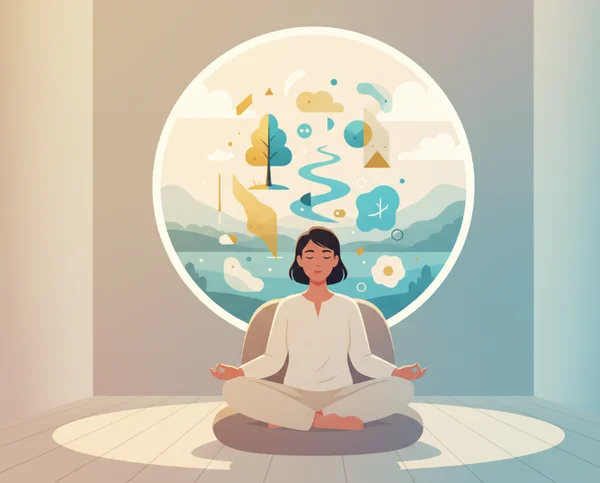
What Is Aphantasia and Why It Matters for Treatment
Before exploring any aphantasia cure, it helps to understand what you're actually dealing with. Aphantasia is the inability to voluntarily create mental images in your mind's eye. When someone tells you to "picture a beach," you understand the concept — but you see nothing.
This matters for treatment because aphantasia isn't one-size-fits-all. The type you have significantly shapes what approaches might work for you.
How Aphantasia Affects Your Daily Experience
People with aphantasia often experience the world differently in ways they don't immediately recognize. You might struggle with:
- Recalling visual memories — remembering facts about events but not "seeing" them
- Following guided meditations — feeling lost when instructors say "visualize a peaceful place"
- Creative tasks — drawing, designing, or writing descriptions that require mental pictures
- Face recognition — recognizing people can be harder without a mental image to reference
However, many people with aphantasia develop powerful compensatory strengths. These include strong logical thinking, factual memory, and conceptual processing.
Congenital vs. Acquired Aphantasia: Why the Distinction Matters
This distinction is critical if you're searching for aphantasia treatment options.
Congenital aphantasia means you've never had mental imagery. Your brain likely developed alternative neural pathways from the start. For you, the concept of "seeing pictures in your head" may feel foreign rather than lost.
Acquired aphantasia develops after brain injury, trauma, or certain medical events. Because your brain once created images, the neural circuitry may still exist — just disrupted. Some researchers believe acquired aphantasia may respond better to targeted interventions.
Understanding which type you have helps set realistic expectations. Neither type is a disorder — both represent variations in how the human brain processes information.
Can Aphantasia Actually Be Cured?
Let's address the core question directly. As of 2026, there is no scientifically proven cure for aphantasia. No medication, surgery, or therapy has been validated through rigorous clinical trials to reliably restore mental imagery.
However, "no cure" doesn't mean "no hope." Several important nuances deserve your attention.
What Current Research Says About an Aphantasia Cure
Research into aphantasia is still relatively young. Professor Adam Zeman at the University of Exeter first coined the term in 2015, making this a field barely a decade old.
Here's what we know so far:
- No pharmaceutical treatments have been developed specifically for aphantasia
- Brain stimulation studies show that direct current stimulation can temporarily influence imagery strength, but effects are modest and short-lived
- Individual case reports document people developing imagery through various training methods, but these lack controlled study conditions
- Neuroimaging research confirms that people with aphantasia show different activation patterns in visual cortex areas, suggesting real neurological differences rather than a "lack of effort"
The scientific community generally frames aphantasia as a fascinating cognitive variation rather than a medical condition requiring treatment.
Why "Improvement" May Be a Better Goal Than "Cure"
Rather than seeking a complete aphantasia cure, many experts suggest focusing on incremental improvement. Here's why this reframing matters:
- Progress is often gradual — people who report gains typically describe months of consistent practice
- Results vary enormously — some individuals develop vivid imagery while others notice only subtle changes
- Awareness often grows first — what feels like "new" visualization may actually be increased awareness of faint imagery that was always present
- Quality of life isn't dependent on visualization — many successful artists, scientists, and professionals have aphantasia
Setting the goal as "exploring and potentially improving your imagery" removes the pressure of an all-or-nothing outcome.
How Image Streaming May Help Strengthen Your Mind's Eye
When people search for an aphantasia cure, image streaming is usually the first technique they encounter. Developed by Win Wenger, this method has generated both enthusiasm and skepticism within the aphantasia community.
Step-by-Step: How to Practice Image Streaming
Image streaming is straightforward to learn, even if results take patience:
- Find a quiet space and close your eyes
- Relax your gaze behind your closed eyelids — don't strain to "see" anything
- Describe out loud whatever you notice, even if it's just darkness, faint light, or vague shapes
- Engage all senses in your descriptions — mention textures, temperatures, sounds, and smells, not just visuals
- Keep talking continuously for at least 10 minutes — the verbal output is essential, not optional
- Practice daily for a minimum of 30 days before evaluating progress
The key principle: verbalizing activates connections between language and visual processing areas. Over time, this may strengthen the neural pathways responsible for mental imagery.
What Results Can You Realistically Expect?
Reported outcomes from image streaming vary widely:
- Some practitioners report noticing faint mental images within weeks
- Others describe achieving vivid visualization after months of consistent daily practice
- A small number of people have reported reaching what they call "full phantasia" after extended training periods of 12–18 months
Important caveat: These reports are largely anecdotal. No peer-reviewed study has conclusively proven that image streaming cures aphantasia. The improvements people describe could represent genuine neural changes, increased awareness of pre-existing faint imagery, or a combination of both.
Why Some People See No Change from Image Streaming
Not everyone responds to this technique. Possible reasons include:
- Congenital vs. acquired differences — those who never had imagery may lack the neural foundation that image streaming tries to activate
- Inconsistent practice — many people underestimate the daily commitment required
- Expectation mismatch — looking for vivid "movie-like" images rather than subtle perceptual shifts
- Individual neurology — brain structure differences mean no single technique works universally
If image streaming doesn't work for you, that's valuable information — not a failure. It simply means exploring other approaches.
Other Techniques Worth Trying for Aphantasia
Beyond image streaming, several other methods deserve attention in the search for aphantasia treatment options. Each comes with different levels of evidence and practical considerations.
Functional Imagery Training (FIT): A Research-Backed Approach
Functional imagery training stands out because it has actual research support. Originally developed to enhance motivation, FIT helps individuals engage multiple senses — not just vision — to build richer mental experiences.
What makes FIT different:
- Multi-sensory focus — you work with sounds, textures, emotions, and spatial awareness, not just pictures
- Goal-oriented — connects imagery practice to meaningful personal goals
- Guided process — typically involves working with a trained facilitator
- Research backing — studies published in peer-reviewed psychology journals show effectiveness for people with weak visualization
For someone with aphantasia, FIT may be more accessible than image streaming because it doesn't require you to "see" images right away. Instead, it builds from whatever sensory strengths you already have.
Brain Training and Cognitive Exercises
Several cognitive approaches may support imagery development:
- Memory palace practice — even without visual images, you can build spatial memory frameworks
- Descriptive writing exercises — detailed scene descriptions activate visual processing regions
- Guided meditation with sensory focus — progressive relaxation combined with multi-sensory prompts
- Drawing from observation — strengthens the connection between visual input and visual memory
These exercises are low-risk, free, and can be practiced independently. While none are proven aphantasia cures, they support overall cognitive flexibility.
What About Brain Stimulation or Psychedelics?
Two more experimental approaches deserve brief mention — with important caveats.
Brain stimulation (tDCS): Research has shown that transcranial direct current stimulation can modestly influence imagery strength during sessions. However, effects tend to fade quickly, and the technology requires professional supervision. Researchers suggest combining stimulation with training for potentially longer-lasting results.
Psychedelics: A small number of case reports describe individuals experiencing mental imagery during or after psychedelic experiences. One notable case involved someone with acquired aphantasia reporting restored visualization after a single session. However, this evidence is extremely limited, results are inconsistent, and psychedelics carry significant legal and health risks. This is not a recommended treatment pathway.
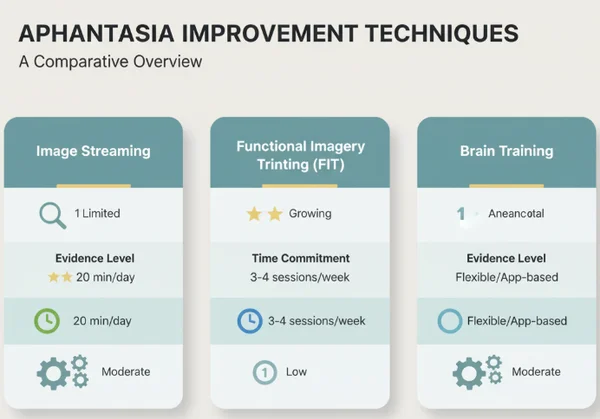
| Technique | Evidence Level | Time Commitment | Accessibility |
|---|---|---|---|
| Image Streaming | Anecdotal | 10+ min/day, 30+ days | Free, self-guided |
| Functional Imagery Training | Moderate research | Sessions with facilitator | May require professional |
| Brain Training Exercises | Low-moderate | Variable | Free, self-guided |
| Brain Stimulation (tDCS) | Early research | Professional sessions | Requires equipment/supervision |
| Psychedelics | Case reports only | Single/rare sessions | Legal restrictions, health risks |
What Neuroplasticity Research Reveals About Aphantasia
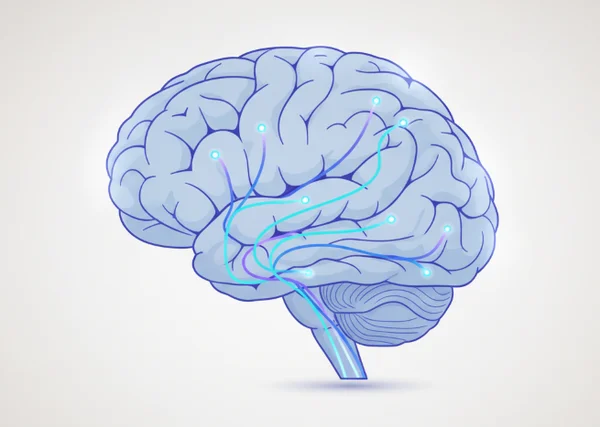
Understanding neuroplasticity — your brain's ability to form new connections throughout life — provides the scientific foundation for why an aphantasia cure or improvement might be possible.
Can Your Brain Learn to Visualize?
The short answer: possibly, but it depends on several factors.
Neuroplasticity research shows that the brain can reorganize itself in response to repeated practice and experience. This principle underlies everything from stroke recovery to learning new languages. For aphantasia, the relevant question is whether visual cortex areas can be trained to activate through deliberate practice.
Evidence supporting this possibility includes:
- Brain imaging studies showing that the visual cortex in people with aphantasia can still respond to actual visual input — the hardware isn't broken, the voluntary activation pathway may just be weaker
- Cases of acquired aphantasia recovery where imagery returned after the underlying cause was treated
- Parallels with other sensory training — blind individuals who develop enhanced auditory processing show that sensory cortex areas can be repurposed
Key Studies and What They Found
While dedicated aphantasia treatment studies are limited, several relevant findings inform our understanding:
- Zeman et al. (2015): The foundational study defining aphantasia and confirming it as a measurable neurological variation through brain imaging
- Pearson et al. (2020s): Research demonstrating that imagery strength exists on a spectrum and can be measured through binocular rivalry tests
- Keogh & Pearson: Studies showing that brain stimulation can temporarily modulate imagery vividness, proving that the neural circuits involved can be influenced externally
- University of New South Wales research: Ongoing work exploring the relationship between imagery ability and memory, dreaming, and creativity
These studies collectively suggest that imagery ability is not fixed and binary but exists on a continuum that may shift with intervention.
How to Explore Your Own Visual Imagination
Now that you understand the landscape of aphantasia treatment, you might be wondering where you personally stand. Before trying any technique, it helps to establish a baseline understanding of your current imagery ability.
Where Do You Fall on the Imagery Spectrum?
Visualization isn't simply "on" or "off." Research shows that imagery ability exists on a wide spectrum:
- Aphantasia — no voluntary mental imagery
- Hypophantasia — weak or dim mental imagery
- Typical imagery — moderate mental pictures
- Hyperphantasia — extremely vivid, lifelike mental imagery
Many people assume they have complete aphantasia when they actually fall somewhere in the hypophantasia range. Understanding your starting point helps you choose appropriate techniques and set realistic goals.
What a Self-Assessment Can Reveal About Your Mind's Eye
Structured self-assessments inspired by the Vividness of Visual Imagery Questionnaire (VVIQ) can help you understand your imagery profile. These tools ask you to attempt specific visualizations and rate your experience.
A well-designed assessment can reveal:
- Whether you have any visual imagery at all (even faint or fleeting)
- Which sensory modalities are strongest for you (some people with visual aphantasia have vivid auditory or tactile imagery)
- How your imagery compares to population averages
- Which areas to focus on if you decide to try improvement techniques
Curious about where you stand? You can take an aphantasia self-assessment based on established research principles. It takes just a few minutes and provides personalized insights into your unique cognitive profile — no diagnosis, just self-understanding.
This assessment is designed for educational self-reflection and does not constitute a medical diagnosis. For clinical concerns, please consult a qualified healthcare professional.
Moving Forward With or Without Mental Imagery
The search for an aphantasia cure reflects a deeply human desire to understand and optimize how our minds work. Here's what matters most as you move forward:
Key takeaways:
- There is currently no proven cure for aphantasia, but improvement is possible for some people through consistent practice
- Image streaming, functional imagery training, and cognitive exercises are the most accessible techniques with varying levels of evidence
- The distinction between congenital and acquired aphantasia may influence which approaches are most likely to help
- Neuroplasticity research supports the possibility of change, even if guaranteed outcomes remain elusive
- Aphantasia is not a disorder — it's a variation that many people live with successfully and even leverage as a cognitive strength
When to consider professional support:
If your inability to visualize causes significant distress, interferes with daily functioning, or developed suddenly after an injury or trauma, speaking with a neurologist or neuropsychologist can provide clarity and guidance tailored to your situation.
Whatever path you choose, remember that understanding your mind is valuable in itself. Whether you develop imagery or learn to thrive without it, the self-awareness you gain from this exploration matters. Ready to take that first step? Explore your visualization ability with our free aphantasia test and discover your unique cognitive profile.
Frequently Asked Questions
Can aphantasia be reversed?
For most people with congenital aphantasia, a full reversal has not been scientifically documented. However, some individuals report gradual improvement through techniques like image streaming and functional imagery training. Acquired aphantasia may have better reversal prospects if the underlying cause is addressed.
Is aphantasia permanent?
Aphantasia appears to be a stable trait for most people, particularly those with the congenital form. However, "permanent" doesn't mean "unchangeable." Some individuals report developing faint imagery over time with dedicated practice, even if complete visualization never develops.
Can aphantasia go away on its own?
Spontaneous resolution of aphantasia is very rare and not well documented in research. Most changes people report come from deliberate practice with specific techniques rather than passive improvement over time.
Can psychedelics help with aphantasia?
A very small number of case reports describe individuals experiencing mental imagery during or after psychedelic use. However, this evidence is extremely limited and inconsistent. Psychedelics carry significant legal and health risks and are not a recommended approach for aphantasia.
What causes aphantasia?
Congenital aphantasia likely involves differences in how visual cortex areas connect with frontal brain regions responsible for voluntary control. Acquired aphantasia can result from brain injury, stroke, or psychological trauma. Research into exact mechanisms is still in early stages.
How long does it take to see results from aphantasia exercises?
Timelines vary enormously between individuals. Some people report noticing faint changes within a few weeks of daily image streaming. Others practice for months before perceiving shifts. Many practitioners recommend committing to at least 30 days of consistent daily practice before evaluating whether a technique is working for you.
When should you consider professional evaluation for aphantasia?
Consider seeking professional guidance if your aphantasia developed suddenly, causes you significant emotional distress, or is accompanied by other cognitive changes. A neuropsychologist can assess your situation comprehensively and suggest appropriate next steps.